How to use this calculator
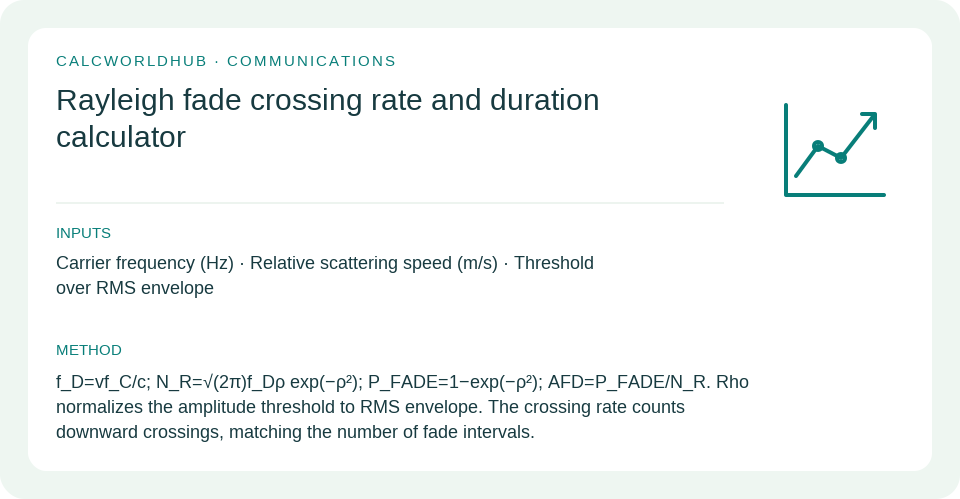
Estimate how frequently a mobile Rayleigh channel crosses a fade threshold and how long a typical below-threshold interval lasts.
- Enter Carrier frequency (Hz), Relative scattering speed (m/s), Threshold over RMS envelope. Match the units shown beside each field and review the result together with the assumptions below.
- Read the worked example below to check the expected input format and result.
- Compare another scenario by changing one input at a time. Use Reset to return to the starting values.
Rayleigh fade crossing rate and duration explained
Inputs, symbols, and units
f— Carrier frequency (Hz)- Radio carrier used to derive maximum Doppler.
v— Relative scattering speed (m/s)- Speed in the isotropic-scattering mobile model.
rho— Threshold over RMS envelope- Envelope threshold divided by RMS envelope, not average amplitude.
Formula and method
f_D=vf_C/c; N_R=√(2π)f_Dρ exp(−ρ²); P_FADE=1−exp(−ρ²); AFD=P_FADE/N_R.
Rho normalizes the amplitude threshold to RMS envelope. The crossing rate counts downward crossings, matching the number of fade intervals.
A worked scenario
Carrier frequency (Hz) = 900000000; Relative scattering speed (m/s) = 15; Threshold over RMS envelope = 0.5.
- Average fade duration: 0.005033 s
- Downward level-crossing rate: 43.954099 1/s
- Fraction below threshold: 0.221199 probability
At 900 MHz and 15 m/s, evaluate a threshold at half the RMS envelope; the fade fraction divided by crossing rate gives average fade duration.
Assumptions and edge cases
Stationary flat Rayleigh fading with isotropic scattering and nonzero speed; line-of-sight Rician channels and burst interference differ.
Reading the outputs
Duration is mean time per fade event, not total outage over a mission. Crossings are per second and fade fraction is dimensionless.
Frequently asked questions
Is rho a power ratio?
No; it is an envelope-amplitude ratio, so its square is a power ratio.
Does twice the speed double outage fraction?
No; it doubles crossings and halves average duration while preserving the same stationary fade fraction.
Can I use zero speed?
The stationary mobile crossing model gives zero crossings and no finite average fade duration at zero speed.
How do I use the Rayleigh fade crossing rate and duration calculator?
Enter Carrier frequency (Hz), Relative scattering speed (m/s), Threshold over RMS envelope. Match the units shown beside each field and review the result together with the assumptions below.
What is a worked example of Rayleigh fade crossing rate and duration?
Carrier frequency (Hz) = 900000000; Relative scattering speed (m/s) = 15; Threshold over RMS envelope = 0.5. Average fade duration: 0.005033 s Downward level-crossing rate: 43.954099 1/s Fraction below threshold: 0.221199 probability At 900 MHz and 15 m/s, evaluate a threshold at half the RMS envelope; the fade fraction divided by crossing rate gives average fade duration.
Background or definition reference: Rayleigh level crossings and fade duration: single-hop limit.
Read our calculation methodology.