How to use this calculator
Calculate the Rayleigh number for buoyancy-driven natural convection from fluid properties and a temperature difference.
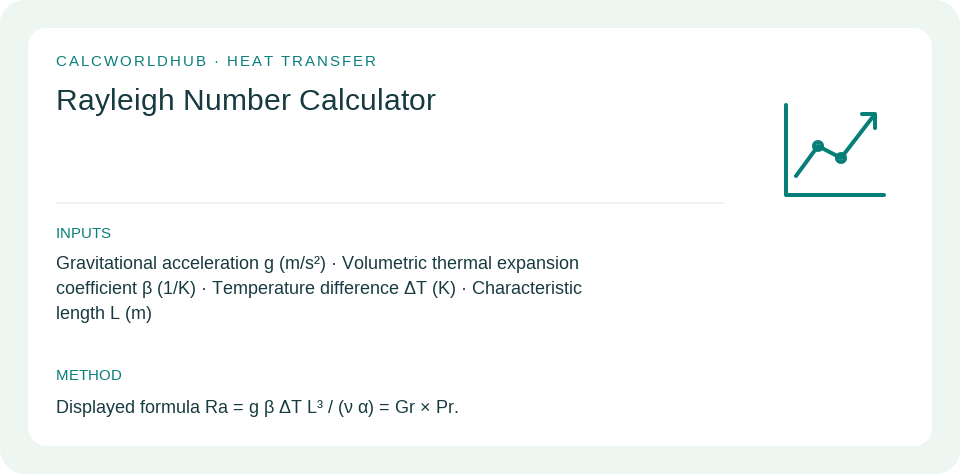
- Enter Gravitational acceleration g (m/s²), Volumetric thermal expansion coefficient β (1/K), Temperature difference ΔT (K), Characteristic length L (m), then complete the remaining labeled fields. Match the units shown beside each field and review the result together with the assumptions below.
- Read the worked example below to check the expected input format and result.
- Compare another scenario by changing one input at a time. Use Reset to return to the starting values.
How this calculation works
The Rayleigh number combines buoyancy, viscous diffusion, and thermal diffusion to characterize natural-convection conditions. For a characteristic length L, it can be calculated as the product of the Grashof number and Prandtl number. The fluid properties should be representative of the relevant film or reference temperature.
Inputs and units
gravity— Gravitational acceleration g (m/s²)- Enter local gravitational acceleration.
beta— Volumetric thermal expansion coefficient β (1/K)- Use the fluid value at the chosen reference temperature.
deltaT— Temperature difference ΔT (K)- Enter a nonnegative temperature difference; a Celsius interval has the same numerical size as a kelvin interval.
length— Characteristic length L (m)- Use the geometry-specific characteristic length.
nu— Kinematic viscosity ν (m²/s)- Enter kinematic viscosity, not dynamic viscosity.
alpha— Thermal diffusivity α (m²/s)- Enter thermal diffusivity for the same fluid and reference condition.
Formula
Ra = g β ΔT L³ / (ν α) = Gr × Pr.
Method
Use absolute temperature difference ΔT in kelvins, thermal expansion coefficient β in K⁻¹, kinematic viscosity ν and thermal diffusivity α in m²/s, and length L in metres.
Worked example
For g = 9.80665 m/s², β = 0.00341 K⁻¹, ΔT = 20 K, L = 0.50 m, ν = 1.6 × 10⁻⁵ m²/s, and α = 2.2 × 10⁻⁵ m²/s, Ra = 2.3750 × 10⁸.
Assumptions and limits
Ra is a dimensionless regime parameter, not a heat-transfer coefficient. Transition ranges depend on geometry, boundary conditions, and property evaluation temperature.
Frequently asked questions
What does the Rayleigh number describe?
It compares buoyancy-driven flow with viscous and thermal diffusion for a selected natural-convection length scale.
How are Rayleigh, Grashof, and Prandtl numbers related?
For this constant-temperature-difference form, Ra = Gr × Pr, where Gr = g β ΔT L³ / ν² and Pr = ν / α.
Which temperature difference should I use?
Use the positive magnitude between the surface and reference fluid temperatures; a temperature interval in kelvins is numerically equal to one in degrees Celsius.
How do I use the Rayleigh Number Calculator?
Enter Gravitational acceleration g (m/s²), Volumetric thermal expansion coefficient β (1/K), Temperature difference ΔT (K), Characteristic length L (m), then complete the remaining labeled fields. Match the units shown beside each field and review the result together with the assumptions below.
What is a worked example of Rayleigh Number?
For g = 9.80665 m/s², β = 0.00341 K⁻¹, ΔT = 20 K, L = 0.50 m, ν = 1.6 × 10⁻⁵ m²/s, and α = 2.2 × 10⁻⁵ m²/s, Ra = 2.3750 × 10⁸.
Reference: technical reference. See our calculation methodology.