RC capacitor charging voltage calculator
Estimate capacitor voltage during a charging step. Enter your values below for a free estimate, with no account required.
inputs.
Calculator
How to use the RC capacitor charging voltage calculator
Estimate capacitor voltage during a charging step. Enter your values below for a free estimate, with no account required.
What this calculator measures
Estimate the voltage across an initially uncharged capacitor during a DC step through a series resistance. The ideal first-order response depends on the RC time constant.
Inputs and units
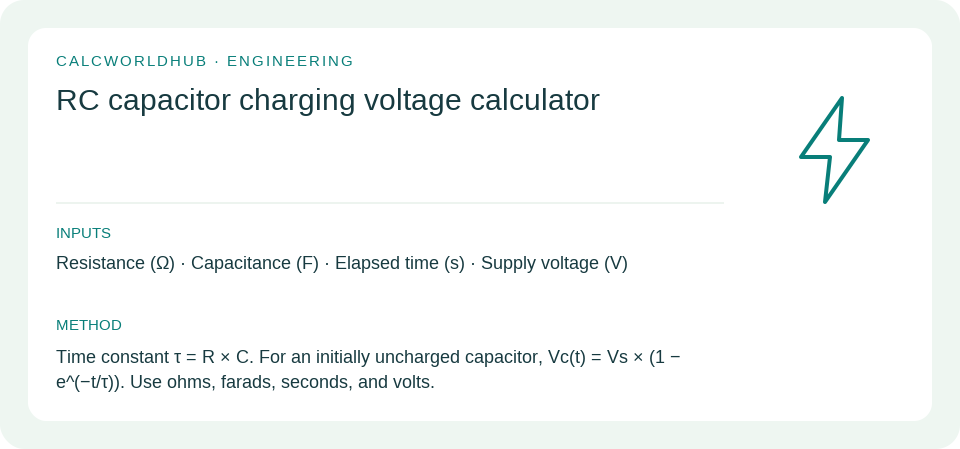
The required fields are Resistance (Ω), Capacitance (F), Elapsed time (s), Supply voltage (V). Each value should describe the same object, sample, transaction, or time period wherever the formula compares them.
- Resistance (Ω): Enter the value that matches the field label and its displayed unit.
- Capacitance (F): Enter the value that matches the field label and its displayed unit.
- Elapsed time (s): Keep the date or time basis consistent with the other entries; check the displayed unit.
- Supply voltage (V): Enter the value that matches the field label and its displayed unit.
Formula and method
Time constant τ = R × C. For an initially uncharged capacitor, Vc(t) = Vs × (1 − e^(−t/τ)). Use ohms, farads, seconds, and volts.
Worked example
For R = 10 kΩ, C = 10 µF, t = 0.2 s and Vs = 5 V, τ = 0.1 s and Vc = 5(1 − e⁻²) ≈ 4.3233 V.
How to use the calculator
- Read the field labels and select values from the same source and measurement basis.
- Enter Resistance (Ω) and the other required values. Use the units printed on the page and convert mixed units first.
- Review the displayed method, then compare the result with the question you are trying to answer.
- Change one input at a time to see which assumption has the greatest effect on the result.
Interpreting the result
At t = 0 the ideal capacitor voltage is zero; it approaches the entered supply voltage asymptotically. After one time constant it has reached about 63.2% of the step voltage.
Assumptions and limits
This is the ideal response of a series RC circuit to a constant source voltage, with the capacitor initially uncharged and no load or leakage path. A nonzero resistance and capacitance are required; parasitic resistance, source impedance, component tolerance, and switching transients are not modeled. See OpenStax RC circuits for the standard first-order model.
This is an idealized calculation based on the entered assumptions. Verify boundary conditions, material properties, safety factors, and applicable standards before using it in a design.
Frequently asked questions
What information do I need?
Enter resistance in ohms, capacitance in farads, elapsed time in seconds, and the constant supply voltage in volts. Convert kΩ and µF to Ω and F if you enter values manually.
How should I interpret the result?
The result is the ideal capacitor voltage at the entered time after the step. Compare elapsed time with τ = RC: near one τ the capacitor is about 63.2% charged, and after several τ it is close to the supply voltage.
Is the RC capacitor charging voltage calculator free to use?
Yes. This calculator is free and works in your browser without an account.
How do I use the RC capacitor charging voltage calculator?
Enter Resistance (Ω), Capacitance (F), Elapsed time (s), Supply voltage (V). Match the units shown beside each field and review the result together with the assumptions below.
What is a worked example of RC capacitor charging voltage?
For R = 10 kΩ, C = 10 µF, t = 0.2 s and Vs = 5 V, τ = 0.1 s and Vc = 5(1 − e⁻²) ≈ 4.3233 V.
Read the calculation methodology and privacy policy.
Good calculators show their work.
CalcWorldHub is built around clear inputs and visible assumptions. Results are estimates for planning; check official sources or your provider’s terms when exact figures matter.