How to use this calculator
Quantify lost intake displacement caused by compressed clearance gas re-expanding before the suction valve opens.
- Enter Clearance volume / swept volume, Discharge to suction pressure ratio, Clearance gas re-expansion exponent, Swept volume per revolution (m³), then complete the remaining labeled fields. Match the units shown beside each field and review the result together with the assumptions below.
- Read the worked example below to check the expected input format and result.
- Compare another scenario by changing one input at a time. Use Reset to return to the starting values.
Reciprocating compressor clearance re-expansion explained
Use Clearance volume / swept volume with Discharge to suction pressure ratio to reproduce the sample calculation, then review the stated limits before carrying the result into another scenario.
A numerical walkthrough
Clearance volume / swept volume = 0.05; Discharge to suction pressure ratio = 5; Clearance gas re-expansion exponent = 1.3; Swept volume per revolution (m³) = 0.001; Single-acting compression cycles per minute = 1000.
- Ideal volumetric efficiency: 87.755951 %
- Suction-volume delivery: 0.014626 m³/s
- Swept-volume rate: 0.016667 m³/s
A compressor with 5% clearance, pressure ratio 5 and re-expansion exponent 1.3 achieves 87.756% ideal volumetric efficiency. At 0.001 m³ swept volume and 1,000 rpm, fresh suction volume is 0.014626 m³/s rather than the 0.016667 m³/s geometric sweep.
The model behind the numbers
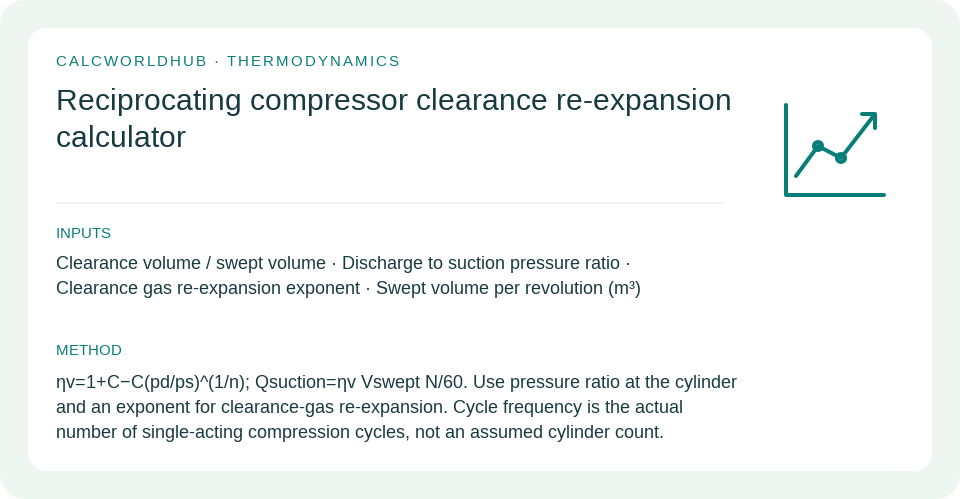
ηv=1+C−C(pd/ps)^(1/n); Qsuction=ηv Vswept N/60.
Use pressure ratio at the cylinder and an exponent for clearance-gas re-expansion. Cycle frequency is the actual number of single-acting compression cycles, not an assumed cylinder count.
What to enter
C— Clearance volume / swept volume- Clearance volume / swept volume. Enter the value for this state; the units shown are used without an unstated conversion.
r— Discharge to suction pressure ratio- Discharge to suction pressure ratio. Enter the value for this state; the units shown are used without an unstated conversion.
n— Clearance gas re-expansion exponent- Clearance gas re-expansion exponent. Enter the value for this state; the units shown are used without an unstated conversion.
V— Swept volume per revolution (m³)- Swept volume per revolution (m³). Enter the value for this state; the units shown are used without an unstated conversion.
rpm— Single-acting compression cycles per minute- Single-acting compression cycles per minute. Enter the value for this state; the units shown are used without an unstated conversion.
Interpreting the result
No valve losses, gas heating on suction, leakage, real-gas correction or multi-cylinder phasing.
Reading the outputs
Reports clearance-only volumetric efficiency, inlet-condition volume delivery and geometric swept-volume rate.
Frequently asked questions
Can volumetric efficiency exceed one?
Not in this clearance-only model for a pressure ratio of at least one.
How do I enter a double-acting machine?
Use total effective swept volume per cycle and an equivalent cycle frequency, after accounting for rod displacement.
Is delivery volume at discharge pressure?
No. It is referenced to suction conditions.
How do I use the Reciprocating compressor clearance re-expansion calculator?
Enter Clearance volume / swept volume, Discharge to suction pressure ratio, Clearance gas re-expansion exponent, Swept volume per revolution (m³), then complete the remaining labeled fields. Match the units shown beside each field and review the result together with the assumptions below.
What is a worked example of Reciprocating compressor clearance re-expansion?
Clearance volume / swept volume = 0.05; Discharge to suction pressure ratio = 5; Clearance gas re-expansion exponent = 1.3; Swept volume per revolution (m³) = 0.001; Single-acting compression cycles per minute = 1000. Ideal volumetric efficiency: 87.755951 % Suction-volume delivery: 0.014626 m³/s Swept-volume rate: 0.016667 m³/s A compressor with 5% clearance, pressure ratio 5 and re-expansion exponent 1.3 achieves 87.756% ideal volumetric efficiency. At 0.001 m³ swept volume and 1,000 rpm, fresh suction volume is 0.014626 m³/s rather than the 0.016667 m³/s geometric sweep.
Read our calculation methodology.