How to use this calculator
Estimate compressor isentropic efficiency from inlet, ideal outlet, and actual outlet specific enthalpy.
- Enter Inlet specific enthalpy (kJ/kg), Isentropic outlet specific enthalpy (kJ/kg), Actual outlet specific enthalpy (kJ/kg). Match the units shown beside each field and review the result together with the assumptions below.
- Read the worked example below to check the expected input format and result.
- Compare another scenario by changing one input at a time. Use Reset to return to the starting values.
How this calculation works
Enter inlet enthalpy, isentropic outlet enthalpy at the same outlet pressure, and actual outlet enthalpy. Keep all values on the same specific-enthalpy basis.
Inputs and units
inletEnthalpy— Inlet specific enthalpy (kJ/kg)- Specific enthalpy at the compressor inlet.
isentropicOutletEnthalpy— Isentropic outlet specific enthalpy (kJ/kg)- Ideal outlet enthalpy for isentropic compression to the selected outlet pressure.
actualOutletEnthalpy— Actual outlet specific enthalpy (kJ/kg)- Measured or calculated actual outlet enthalpy at the same outlet pressure.
Formula
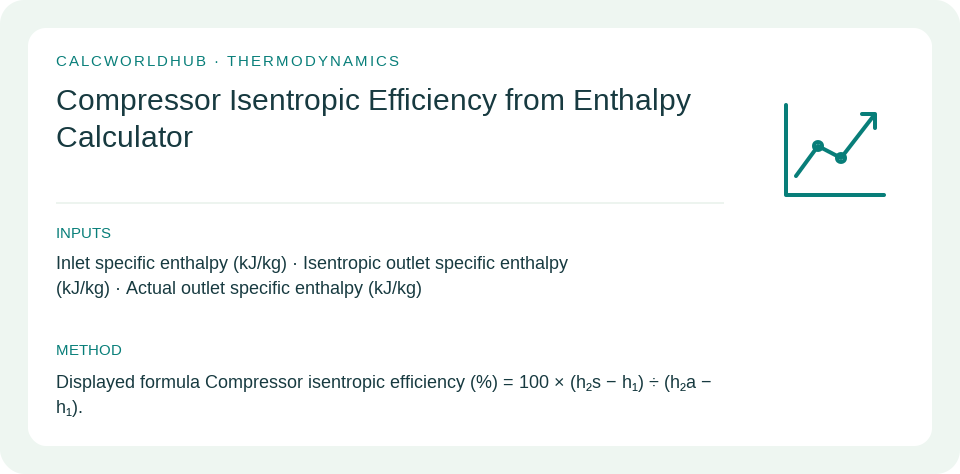
Compressor isentropic efficiency (%) = 100 × (h₂s − h₁) ÷ (h₂a − h₁).
Method
Calculate the ideal isentropic and measured actual enthalpy rises from the same inlet state. Divide ideal rise by actual rise and multiply by 100.
Worked example
For h₁ = 300, h₂s = 350, and h₂a = 370 kJ/kg, ideal rise is 50 kJ/kg, actual rise is 70 kJ/kg, and efficiency is 71.43%.
Assumptions and limits
This enthalpy ratio assumes the inlet and outlet states are correctly paired at the same pressure endpoints. It is not a package efficiency or electrical energy efficiency and does not include motor or mechanical losses.
Frequently asked questions
What does isentropic efficiency compare?
It compares the ideal reversible adiabatic enthalpy rise with the actual enthalpy rise for the same compression endpoints.
Does it include motor efficiency?
No. This is a working-fluid compressor efficiency based on enthalpy changes.
Why must outlet pressures match?
The isentropic and actual outlet states must refer to the same pressure endpoint to make the work comparison meaningful.
How do I use the Compressor Isentropic Efficiency from Enthalpy Calculator?
Enter Inlet specific enthalpy (kJ/kg), Isentropic outlet specific enthalpy (kJ/kg), Actual outlet specific enthalpy (kJ/kg). Match the units shown beside each field and review the result together with the assumptions below.
What is a worked example of Compressor Isentropic Efficiency from Enthalpy?
For h₁ = 300, h₂s = 350, and h₂a = 370 kJ/kg, ideal rise is 50 kJ/kg, actual rise is 70 kJ/kg, and efficiency is 71.43%.
Reference: Purdue University compressor isentropic-efficiency relation from ideal and actual enthalpy rise. See our calculation methodology.