How to use this calculator
Find the critical flow depth in a rectangular open channel from discharge and channel width, then estimate velocity and specific energy at that depth.
- Enter Discharge Q (m³/s), Channel width b (m), Gravitational acceleration g (m/s²). Match the units shown beside each field and review the result together with the assumptions below.
- Read the worked example below to check the expected input format and result.
- Compare another scenario by changing one input at a time. Use Reset to return to the starting values.
How this calculation works
Critical depth is the depth associated with minimum specific energy for a given discharge and channel section under the model assumptions. For a rectangular channel, unit discharge gives a direct cube-root solution, so no iterative cross-section solver is needed.
Inputs and units
flow— Discharge Q (m³/s)- Enter the volume flow rate through the rectangular section.
width— Channel width b (m)- Enter the clear rectangular bottom width; the model assumes vertical sides.
gravity— Gravitational acceleration g (m/s²)- Use local gravitational acceleration if a nonstandard value is required.
Formula
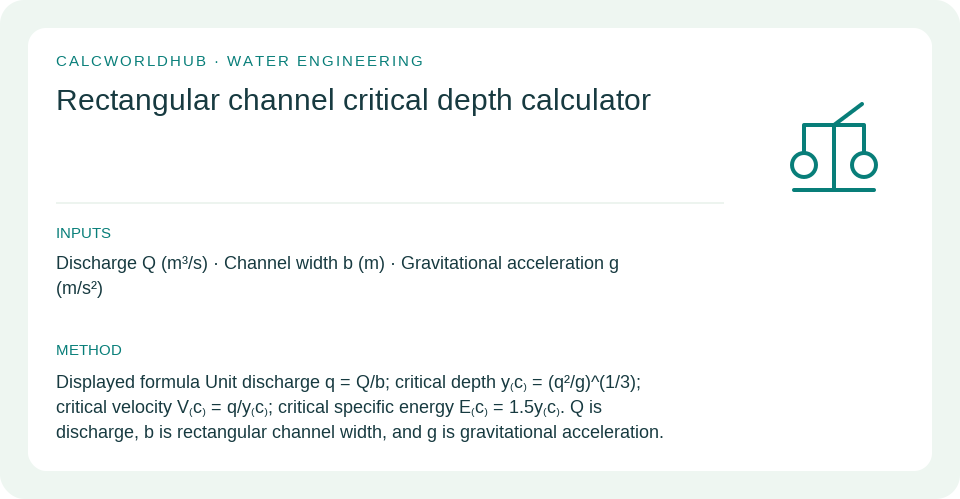
Unit discharge q = Q/b; critical depth y₍c₎ = (q²/g)^(1/3); critical velocity V₍c₎ = q/y₍c₎; critical specific energy E₍c₎ = 1.5y₍c₎. Q is discharge, b is rectangular channel width, and g is gravitational acceleration.
Method
The rectangular section has area A = b y and top width T = b. Applying the critical-flow relation Q²/g = A³/T and substituting those geometry terms gives y₍c₎ = (Q²/(g b²))^(1/3). Velocity and specific energy follow from continuity and the rectangular critical-flow condition.
Worked example
With Q = 2.0 m³/s, b = 2.0 m, and g = 9.80665 m/s², unit discharge is 1.0 m²/s and critical depth is about 0.4672 m. Velocity is about 2.1405 m/s and specific energy is about 0.7008 m.
Assumptions and limits
This result assumes steady one-dimensional flow, a prismatic rectangular section, hydrostatic pressure distribution, and a uniform velocity coefficient of one. It does not account for roughness, losses, nonrectangular geometry, transitions, sediment, air entrainment, or unsteady flow; it is not a site design check.
Frequently asked questions
What does critical depth mean?
It is the depth at which specific energy is minimum for a given discharge and channel geometry in the assumed flow model.
Does channel roughness affect this calculation?
Not in the ideal critical-depth relation used here. Roughness affects energy losses and gradually varied profiles, which are outside this direct section calculation.
Can I use the formula for a trapezoidal channel?
No. This tool assumes a rectangular section. A trapezoid has depth-dependent area and top width and generally requires solving the critical-flow condition iteratively.
Is the result a safe culvert or channel design depth?
No. Check boundary conditions, transitions, freeboard, tailwater, losses, and applicable design guidance for a real structure.
How do I use the Rectangular channel critical depth calculator?
Enter Discharge Q (m³/s), Channel width b (m), Gravitational acceleration g (m/s²). Match the units shown beside each field and review the result together with the assumptions below.
Reference: USACE HEC-RAS explanation of critical depth and specific energy. See our calculation methodology.