How to use this calculator
List the lowest axial, tangential, and oblique mode frequencies of an ideal rectangular room.
- Enter Room length (m), Room width (m), Room height (m), Sound speed (m/s), then complete the remaining labeled fields. Match the units shown beside each field and review the result together with the assumptions below.
- Read the worked example below to check the expected input format and result.
- Compare another scenario by changing one input at a time. Use Reset to return to the starting values.
Rectangular room resonance modes explained
For a 5×4×3 m room and sound speed 343 m/s, the first axial mode (1,0,0) is 343/(2×5)=34.3 Hz; the next width mode is 42.875 Hz.
Inputs, symbols, and units
x— Room length (m)- Room length (m).
y— Room width (m)- Room width (m).
z— Room height (m)- Room height (m).
c— Sound speed (m/s)- Sound speed (m/s).
n— Maximum index on each axis- Maximum index on each axis. Enter a whole number.
Formula and method
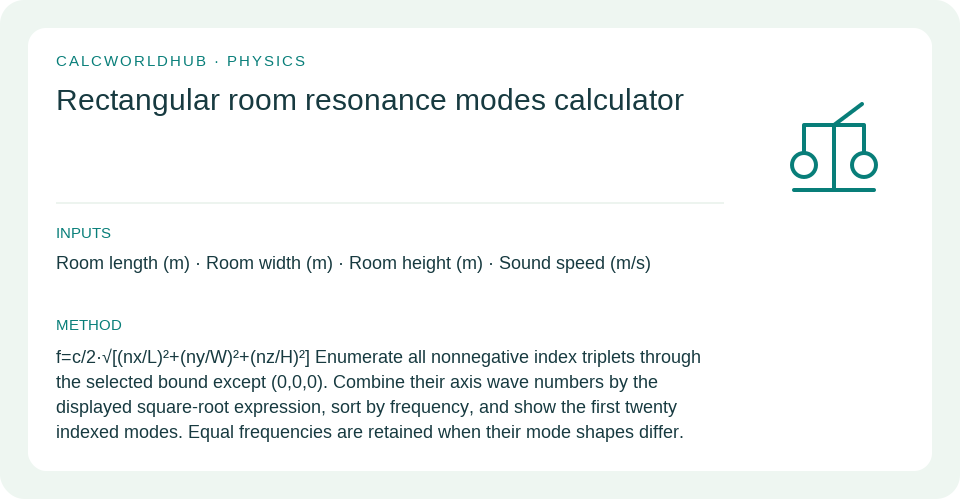
f=c/2·√[(nx/L)²+(ny/W)²+(nz/H)²]
Enumerate all nonnegative index triplets through the selected bound except (0,0,0). Combine their axis wave numbers by the displayed square-root expression, sort by frequency, and show the first twenty indexed modes. Equal frequencies are retained when their mode shapes differ.
A worked scenario
Room length (m) = 5; Room width (m) = 4; Room height (m) = 3; Sound speed (m/s) = 343; Maximum index on each axis = 3.
- Lowest nonzero room mode: 34.3 Hz
- Lowest twenty indexed modes: 34.3 Hz (1,0,0); 42.875 Hz (0,1,0); 54.9068 Hz (1,1,0); 57.1667 Hz (0,0,1); 66.6672 Hz (1,0,1); 68.6 Hz (2,0,0); 71.4583 Hz (0,1,1); 79.264 Hz (1,1,1); 80.8964 Hz (2,1,0); 85.75 Hz (0,2,0); 89.2972 Hz (2,0,1); 92.3556 Hz (1,2,0); 99.0568 Hz (2,1,1); 102.9 Hz (3,0,0); 103.0587 Hz (0,2,1); 108.6167 Hz (1,2,1); 109.8136 Hz (2,2,0); 111.475 Hz (3,1,0); 114.3333 Hz (0,0,2); 117.7134 Hz (3,0,1)
The longest room dimension is 5 m. Its first axial mode is 343/(2×5)=34.3 Hz, lower than the corresponding 4 m and 3 m axial modes.
Assumptions and edge cases
Rigid rectangular boundaries and a uniform sound speed; damping, furnishings, openings, and nonrectangular geometry are excluded. Degenerate modes remain separate.
Frequently asked questions
Are equal-frequency modes merged?
No, their distinct index triplets are retained.
Is this a frequency-response prediction at a seat?
No, mode excitation and observation positions matter.
Why exclude 0,0,0?
It is the zero-frequency uniform-pressure state.
How do I use the Rectangular room resonance modes calculator?
Enter Room length (m), Room width (m), Room height (m), Sound speed (m/s), then complete the remaining labeled fields. Match the units shown beside each field and review the result together with the assumptions below.
What is a worked example of Rectangular room resonance modes?
Room length (m) = 5; Room width (m) = 4; Room height (m) = 3; Sound speed (m/s) = 343; Maximum index on each axis = 3. Lowest nonzero room mode: 34.3 Hz Lowest twenty indexed modes: 34.3 Hz (1,0,0); 42.875 Hz (0,1,0); 54.9068 Hz (1,1,0); 57.1667 Hz (0,0,1); 66.6672 Hz (1,0,1); 68.6 Hz (2,0,0); 71.4583 Hz (0,1,1); 79.264 Hz (1,1,1); 80.8964 Hz (2,1,0); 85.75 Hz (0,2,0); 89.2972 Hz (2,0,1); 92.3556 Hz (1,2,0); 99.0568 Hz (2,1,1); 102.9 Hz (3,0,0); 103.0587 Hz (0,2,1); 108.6167 Hz (1,2,1); 109.8136 Hz (2,2,0); 111.475 Hz (3,1,0); 114.3333 Hz (0,0,2); 117.7134 Hz (3,0,1) The longest room dimension is 5 m.
Read our calculation methodology.