How to use this calculator
Estimate received RF power and link margin from transmit power, antenna gains, path distance, and losses.
- Enter Transmit power (dBm), Transmit antenna gain (dBi), Receive antenna gain (dBi), Frequency (MHz), then complete the remaining labeled fields. Match the units shown beside each field and review the result together with the assumptions below.
- Read the worked example below to check the expected input format and result.
- Compare another scenario by changing one input at a time. Use Reset to return to the starting values.
How this calculation works
A basic point-to-point link budget adds transmit power and antenna gains, then subtracts feeder losses and free-space path loss. The remaining received power can be compared with receiver sensitivity to estimate a nominal margin before implementation-specific fading and interference allowances.
Inputs and units
tx— Transmit power (dBm)- Power delivered to the transmit feed point before the entered feeder loss.
gtx— Transmit antenna gain (dBi)- Gain relative to an isotropic radiator in the link direction.
grx— Receive antenna gain (dBi)- Receive antenna gain in the direction of the transmitter.
frequency— Frequency (MHz)- Carrier frequency in megahertz.
distance— Path distance (km)- Straight-line link distance in kilometres.
txLoss— Transmit-side losses (dB)- Total cable, connector, and other known transmit-side loss.
rxLoss— Receive-side losses (dB)- Total known loss between receive antenna and receiver input.
threshold— Receiver threshold (dBm)- Sensitivity or design threshold at the required data rate and quality.
Formula
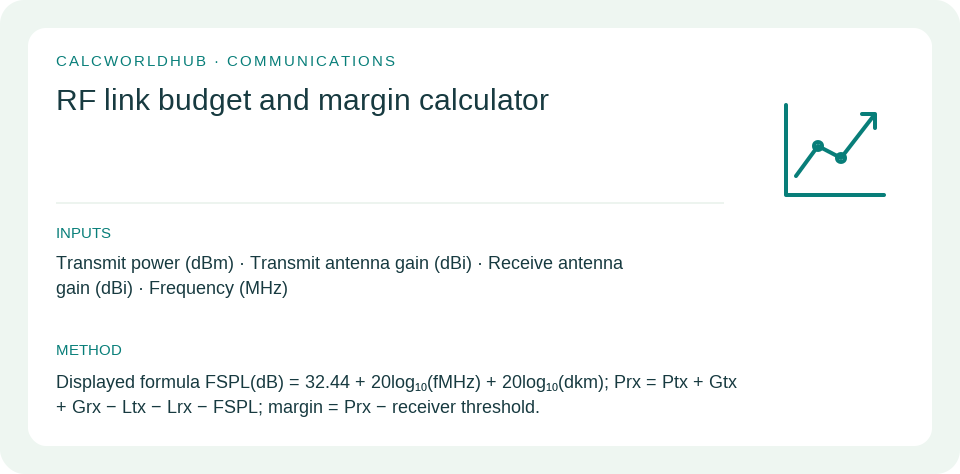
FSPL(dB) = 32.44 + 20log₁₀(fMHz) + 20log₁₀(dkm); Prx = Ptx + Gtx + Grx − Ltx − Lrx − FSPL; margin = Prx − receiver threshold.
Method
Enter power and receiver threshold in dBm, antenna gains and losses in dB, frequency in MHz, and path distance in kilometres. The estimate assumes a free-space path and compatible antenna polarization and impedance.
Worked example
At 2,400 MHz over 1 km, FSPL is about 100.04 dB. With 30 dBm transmit power, 2 dBi antennas at both ends, and 1 dB loss at each end, received power is about −68.04 dBm; against −90 dBm sensitivity, the margin is about 21.96 dB.
Assumptions and limits
Free-space loss omits terrain, buildings, atmospheric effects, multipath, polarization mismatch, feeder mismatch, interference, and implementation losses not entered. The calculated margin is not a coverage guarantee or a substitute for regulatory and engineered link planning.
Frequently asked questions
What does a positive link margin mean?
The free-space received-power estimate is above the entered receiver threshold by that number of decibels.
Does this include fading or building penetration?
No. Add suitable fade, obstruction, penetration, interference, and implementation allowances to a real design.
Why is frequency entered in MHz and distance in kilometres?
Those units match the 32.44 dB constant in this common form of the free-space loss equation.
Can antenna gain be negative?
Yes. An antenna gain below 0 dBi is valid if it matches the antenna's directional gain convention and measurement.
How do I use the RF link budget and margin calculator?
Enter Transmit power (dBm), Transmit antenna gain (dBi), Receive antenna gain (dBi), Frequency (MHz), then complete the remaining labeled fields. Match the units shown beside each field and review the result together with the assumptions below.
Reference: ITU-R Recommendation P.525 on free-space attenuation. See our calculation methodology.