How to use this calculator
Estimate a repeating waveform frequency from interpolated rising zero crossings.
- Enter Uniform samples (signal units), Sampling frequency (Hz). Match the units shown beside each field and review the result together with the assumptions below.
- Read the worked example below to check the expected input format and result.
- Compare another scenario by changing one input at a time. Use Reset to return to the starting values.
Rising zero crossing frequency estimate explained
Use Uniform samples (signal units) with Sampling frequency (Hz) to reproduce the sample calculation, then review the stated limits before carrying the result into another scenario.
A numerical walkthrough
Uniform samples (signal units) = [-0.5, 0.5, 1, 0.2, -1, -0.5, 0.5, 1, 0.2, -1, -0.5, 0.5]; Sampling frequency (Hz) = 10.
- Estimated frequency: 2 Hz
- Mean rising-crossing period: 0.5 s
- Rising crossing count: 3 crossings
The default record has three rising crossings spaced about half a second apart at a ten-hertz sample rate.
The model behind the numbers
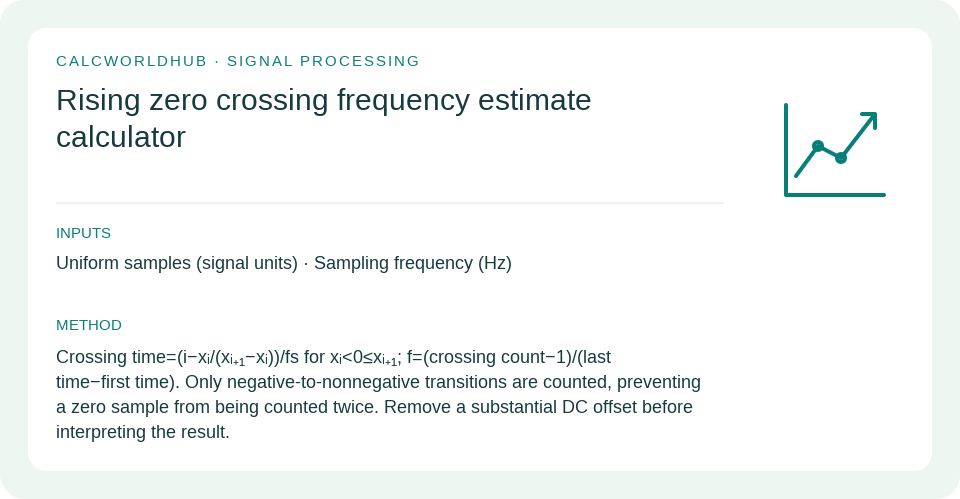
Crossing time=(i−xᵢ/(xᵢ₊₁−xᵢ))/fs for xᵢ<0≤xᵢ₊₁; f=(crossing count−1)/(last time−first time).
Only negative-to-nonnegative transitions are counted, preventing a zero sample from being counted twice. Remove a substantial DC offset before interpreting the result.
What to enter
x— Uniform samples (signal units)- Chronological real samples; use a comma-separated list in the same signal units. Use comma-separated values in the stated order.
fs— Sampling frequency (Hz)- Uniform samples per second; must be positive.
Interpreting the result
No hysteresis or noise rejection. Extra noisy crossings can severely bias the estimate.
Reading the outputs
Frequency is the reciprocal mean crossing interval; the count shows how many timing events support the estimate.
Frequently asked questions
Why only rising crossings?
Using one direction measures complete cycles rather than half cycles.
Does a zero sample count twice?
No. Only the transition from a strictly negative sample is accepted.
What if my waveform never crosses zero?
Remove its baseline appropriately or use a sinusoidal fit.
How do I use the Rising zero crossing frequency estimate calculator?
Enter Uniform samples (signal units), Sampling frequency (Hz). Match the units shown beside each field and review the result together with the assumptions below.
What is a worked example of Rising zero crossing frequency estimate?
Uniform samples (signal units) = [-0.5, 0.5, 1, 0.2, -1, -0.5, 0.5, 1, 0.2, -1, -0.5, 0.5]; Sampling frequency (Hz) = 10. Estimated frequency: 2 Hz Mean rising-crossing period: 0.5 s Rising crossing count: 3 crossings The default record has three rising crossings spaced about half a second apart at a ten-hertz sample rate.
Read our calculation methodology.