How to use this calculator
Estimate total and readily available soil water from field capacity, wilting point, rooting depth, and allowable depletion.
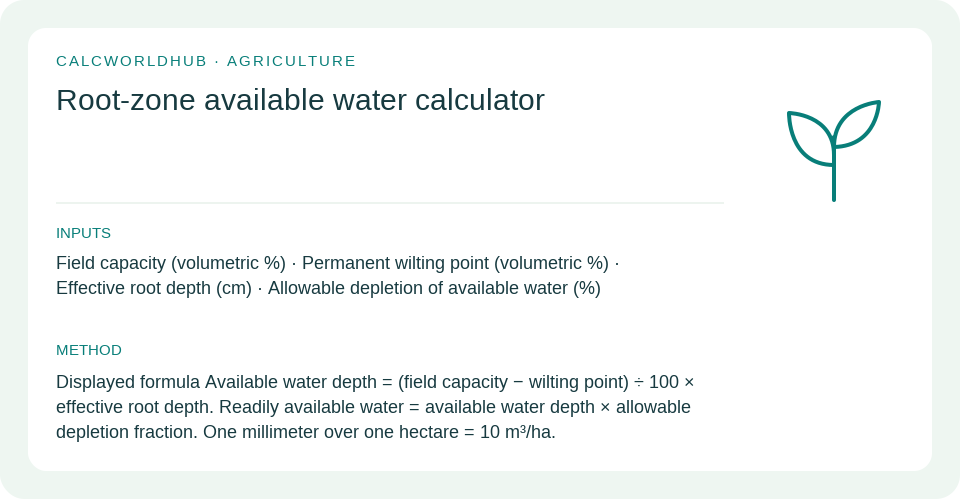
- Enter Field capacity (volumetric %), Permanent wilting point (volumetric %), Effective root depth (cm), Allowable depletion of available water (%). Match the units shown beside each field and review the result together with the assumptions below.
- Read the worked example below to check the expected input format and result.
- Compare another scenario by changing one input at a time. Use Reset to return to the starting values.
How this calculation works
Plant-available water is the soil water held between field capacity and permanent wilting point. Multiplying that difference by the effective root depth estimates the root-zone water reserve; an allowable-depletion fraction gives a simple irrigation trigger depth.
Inputs and units
fieldCapacity— Field capacity (volumetric %)- Representative water content after free drainage, on a volumetric basis.
wiltingPoint— Permanent wilting point (volumetric %)- Representative volumetric water content at the lower plant-available limit.
rootDepthCm— Effective root depth (cm)- Soil depth actively supplying water to the crop.
depletionPercent— Allowable depletion of available water (%)- Fraction of total available root-zone water that may be depleted before the chosen trigger.
Formula
Available water depth = (field capacity − wilting point) ÷ 100 × effective root depth. Readily available water = available water depth × allowable depletion fraction. One millimeter over one hectare = 10 m³/ha.
Method
Enter volumetric soil-water percentages and effective rooting depth in centimeters. The depletion setting is a user-selected fraction of total available water; convert the final depth to volume per area using the displayed unit relationship.
Worked example
At 28% field capacity, 12% wilting point, 60 cm effective rooting depth, and 40% allowable depletion, available water is (0.28 − 0.12) × 600 = 96 mm. The chosen irrigation trigger is 38.4 mm, equivalent to 384 m³/ha.
Assumptions and limits
The calculation assumes a uniform root zone and a single representative field-capacity and wilting-point value. Layered soils, salinity, root restrictions, crop growth stage, rainfall, and measured current water deficit are not modeled. Allowable depletion depends on crop and conditions.
Frequently asked questions
What is plant-available water?
It is the water held between field capacity and permanent wilting point for the selected soil conditions.
Does readily available water equal the current soil deficit?
No. It is a threshold based on a selected allowable-depletion percentage; current deficit requires separate measurements or a water-balance model.
Why does soil texture matter?
Texture and structure affect field capacity and wilting point. Use representative local soil data rather than a generic value when planning irrigation.
How do I use the Root-zone available water calculator?
Enter Field capacity (volumetric %), Permanent wilting point (volumetric %), Effective root depth (cm), Allowable depletion of available water (%). Match the units shown beside each field and review the result together with the assumptions below.
What is a worked example of Root-zone available water?
At 28% field capacity, 12% wilting point, 60 cm effective rooting depth, and 40% allowable depletion, available water is (0.28 − 0.12) × 600 = 96 mm. The chosen irrigation trigger is 38.4 mm, equivalent to 384 m³/ha.
Reference: University of Minnesota Extension grain drying guidance. See our calculation methodology.