How to use this calculator
Estimate field-applied irrigation depth after effective rain and application losses are accounted for.
- Enter Crop water use (mm), Effective rainfall (mm), Application efficiency (%). Match the units shown beside each field and review the result together with the assumptions below.
- Read the worked example below to check the expected input format and result.
- Compare another scenario by changing one input at a time. Use Reset to return to the starting values.
Gross irrigation requirement after rainfall and application efficiency explained
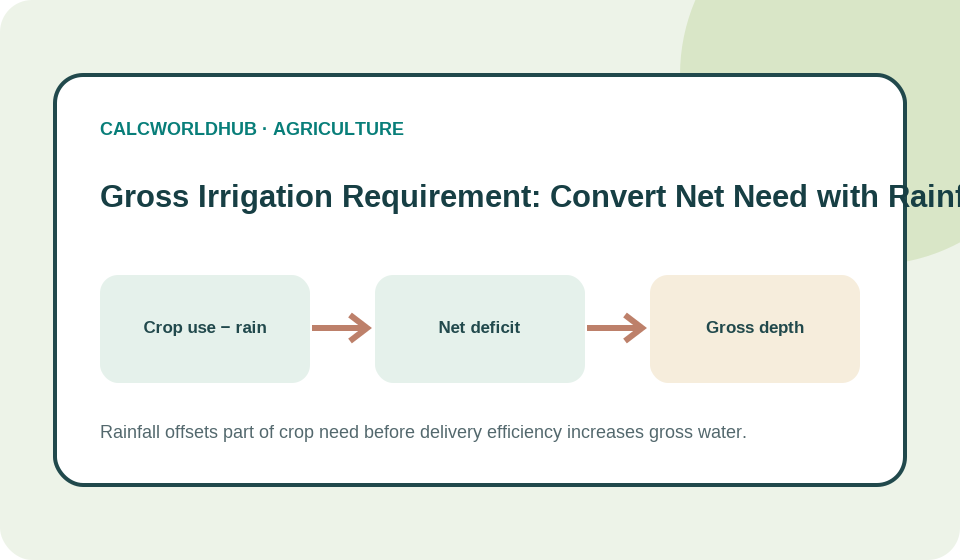
Subtract effective rainfall from crop demand, then divide the remaining root-zone deficit by application efficiency.
How the calculation works
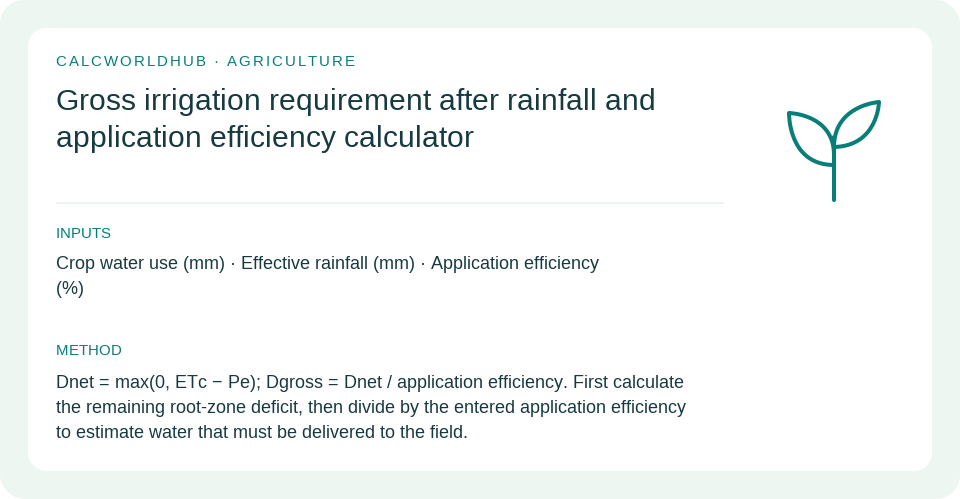
Dnet = max(0, ETc − Pe); Dgross = Dnet / application efficiency.
First calculate the remaining root-zone deficit, then divide by the entered application efficiency to estimate water that must be delivered to the field.
Set up the calculation
etc— Crop water use (mm)- Crop evapotranspiration over the selected period.
rain— Effective rainfall (mm)- Rain remaining in the root zone for the same period.
eff— Application efficiency (%)- Share of applied water that reaches the intended root-zone storage.
Limits of this model
Efficiency is user-supplied and treated as constant. Storage limits, runoff, salinity leaching, and distribution nonuniformity are not separately modeled.
Check this example
Crop water use (mm) = 35; Effective rainfall (mm) = 8; Application efficiency (%) = 78.
- Net root-zone deficit: 27 mm
- Gross field application: 34.615385 mm
- Gross volume per hectare: 346.153846 m³/ha
With ETc 35 mm, effective rain 8 mm, and 78% efficiency, net deficit is 27 mm and gross application is about 34.62 mm.
Reading the outputs
The main result is gross irrigation application depth; supporting outputs are labeled with their own units. Gross depth is the net root-zone deficit divided by efficiency; convert depth to volume separately using the field area.
Frequently asked questions
What does gross irrigation requirement after rainfall and application efficiency show?
With ETc 35 mm, effective rain 8 mm, and 78% efficiency, net deficit is 27 mm and gross application is about 34.62 mm.
Which inputs determine gross irrigation application depth?
First calculate the remaining root-zone deficit, then divide by the entered application efficiency to estimate water that must be delivered to the field.
What does this estimate leave out?
Efficiency is user-supplied and treated as constant. Storage limits, runoff, salinity leaching, and distribution nonuniformity are not separately modeled.
How do I use the Gross irrigation requirement after rainfall and application efficiency calculator?
Enter Crop water use (mm), Effective rainfall (mm), Application efficiency (%). Match the units shown beside each field and review the result together with the assumptions below.
What is a worked example of Gross irrigation requirement after rainfall and application efficiency?
Crop water use (mm) = 35; Effective rainfall (mm) = 8; Application efficiency (%) = 78. Net root-zone deficit: 27 mm Gross field application: 34.615385 mm Gross volume per hectare: 346.153846 m³/ha With ETc 35 mm, effective rain 8 mm, and 78% efficiency, net deficit is 27 mm and gross application is about 34.62 mm.
Read our calculation methodology.