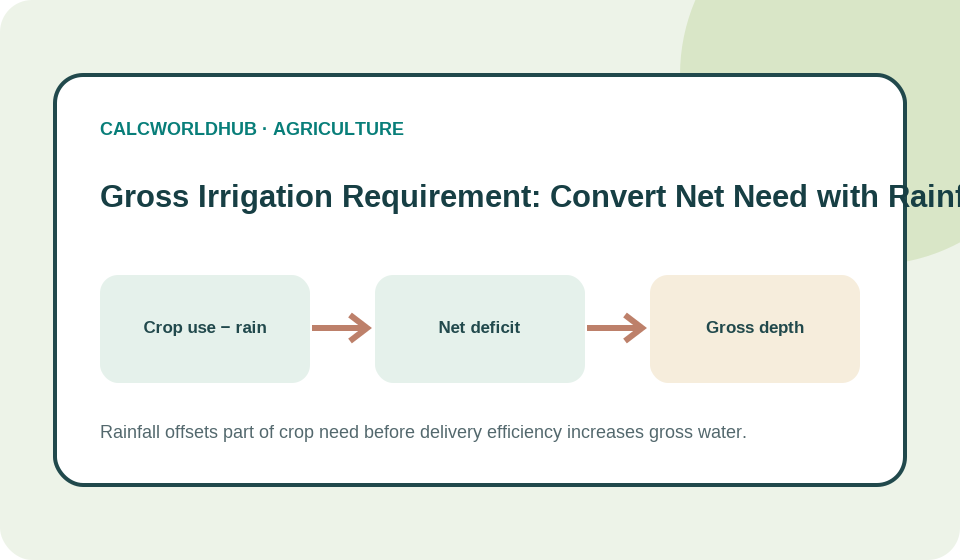

Separate the net water need from the applied amount
Crop water use and effective rainfall are both entered as millimetres over the same period and area. The calculator subtracts rainfall from crop use to estimate a net deficit. It does not estimate effective rainfall itself, so use a value that already represents water available to the crop rather than total rain measured at a weather station.
If rainfall equals or exceeds crop water use, the irrigation deficit cannot be negative for this simplified calculation; the net need is treated as zero. A zero output does not mean the field has no water-management needs, only that these inputs do not produce a positive deficit under this model.
Divide by application efficiency
Application efficiency is entered as a percentage and converted to a fraction. Gross depth equals net deficit divided by that fraction. At 78% efficiency, 27 mm of net root-zone need corresponds to about 34.615 mm of gross application in the calculator’s simplified accounting.
The efficiency adjustment represents losses between applied water and the useful amount assumed to reach the root zone. It is not a crop coefficient or a measurement of uniformity. Real system performance can vary across a field and by operating conditions, so choose an efficiency value suited to the system and the decision.
Convert a water depth into volume per hectare
One millimetre spread over one hectare equals 10 cubic metres. Multiply the gross millimetres by 10 to obtain cubic metres per hectare. This conversion is geometric: one hectare is 10,000 m², and a 1 mm layer is 0.001 m deep.
The volume output is per hectare, not total farm delivery. Multiply it by the irrigated hectares to estimate a field total only when the same crop need, rainfall, and efficiency assumptions apply across that area. For variable zones, calculate or model each zone separately rather than averaging unlike conditions without checking the effect.
Use the result within an irrigation schedule
A season-long total and a single irrigation event are not the same quantity. The calculator has no date, soil-water storage, root depth, allowable depletion, forecast, or irrigation interval. Its output cannot tell you when to irrigate or how quickly the crop is approaching stress.
FAO irrigation methods distinguish crop need, effective precipitation, and gross supply after efficiency losses. For an operational schedule, use local crop-water guidance, soil monitoring, and the actual system. This result is a transparent arithmetic step within that broader process, not a replacement for it.
Avoid mixing water-balance terms
Use crop water use and effective rainfall from the same time window. If the crop-use value is daily but rain is cumulative for a week, subtraction is not meaningful. Also confirm that both values refer to the same root zone or planning layer if a separate agronomic method supplies them.
Do not subtract total rainfall twice if the crop-water figure was already expressed as a net irrigation requirement. Conversely, do not treat rainfall that ran off, drained below roots, or arrived outside the chosen period as fully effective. The input definition matters as much as the arithmetic.
Interpret uncertainty and round transparently
A reported efficiency is an assumption or measured system characteristic, not a guarantee that every part of the field receives the same depth. Small efficiencies amplify the gross-depth estimate because division by a smaller fraction increases the required application. A slightly different rainfall estimate can also change the net deficit.
Keep full precision through the division and depth-to-volume conversion, then round the final value to the precision supported by the inputs. If a rounded depth is passed to an irrigation controller, retain the underlying assumptions and the operational unit conversion rather than treating the displayed digits as measurement accuracy.
Worked examples
The examples show the net deficit, the efficiency adjustment, and the equivalent water volume per hectare.
A 27 mm root-zone deficit
Inputs: Crop water use = 35 mm; effective rainfall = 8 mm; application efficiency = 78%.
Calculation: Net deficit = 35 − 8 = 27 mm. Gross depth = 27 ÷ 0.78 = 34.615385 mm. Volume = 34.615385 × 10 = 346.15385 m³/ha.
The gross estimate is about 34.62 mm, equivalent to about 346.15 m³ per hectare.
A larger deficit at 75% efficiency
Inputs: Crop water use = 48 mm; effective rainfall = 13 mm; application efficiency = 75%.
Calculation: Net deficit = 48 − 13 = 35 mm. Gross depth = 35 ÷ 0.75 = 46.666667 mm. Volume = 46.666667 × 10 = 466.66667 m³/ha.
The lower efficiency requires a larger gross application than the net deficit; this remains an estimate for the entered assumptions.
