
Name the population being estimated
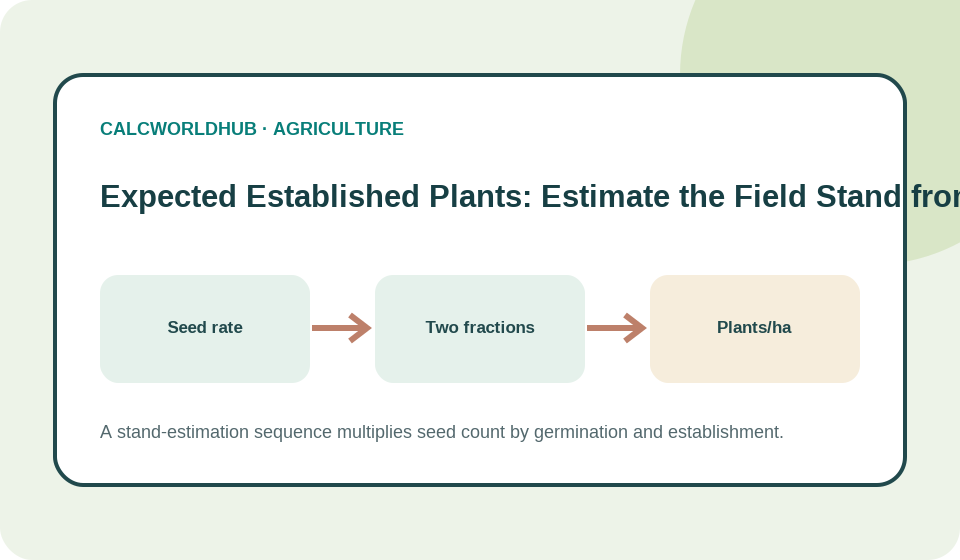
The input seed rate is a count of seeds sown per hectare. The output is an expected count of established plants per hectare after the two entered percentages are applied. Keep these quantities distinct: a planting monitor may display seeds, while a crop stand count records emerged plants.
Use the same area basis for the seed rate and result. If your rate is seeds per acre, convert it before entering a per-hectare field or convert the result back after calculation. Mixing area units can create a numerically plausible answer that is off by the conversion factor.
Apply germination and establishment separately
The formula is seed rate × germination fraction × field-establishment fraction. For example, a 92% test result is 0.92 in the multiplication, not 92. Entering 92 in a field labeled percent is correct because the calculator handles the percent conversion; the written equation should still show the fraction.
The two percentages answer different questions. Germination is seed viability under the test conditions. Field establishment represents the share of germinated seed expected to become part of the stand. The model applies both once and does not add a separate loss factor.
Understand why the result is an expectation
A percentage-based result can be fractional even though plants are counted as whole organisms. That fractional figure is an average expectation over the hectare, not a claim that a field contains a fraction of a plant at a particular point. Round the result only to a useful reporting precision.
The estimate is sensitive to both percentages. If the germination fraction or establishment fraction falls, the expected stand falls in direct proportion. That sensitivity can help compare assumptions, but it does not show which factor caused a shortfall or how to correct it.
Keep field establishment grounded in local conditions
Field emergence depends on seedbed moisture, temperature, planting depth, seed-to-soil contact, compaction, crusting, pests, and equipment performance. A germination result from a lab is not a prediction of field emergence, and an establishment percentage from one field may not transfer to another crop or season.
Choose values from the relevant seed test, local trials, extension advice, or your own documented field records. Avoid treating a single percentage as universal. If the crop or management system has a recommended seeding rate already adjusted for expected losses, do not apply the same adjustment again.
Use the estimate with a planting plan
The calculator does not include row spacing, seeds per metre, a planter’s singulation, or within-field variability. To move from plants per hectare to a row-level target, the planted area per row length must also be known. Machinery calibration remains a separate task.
A practical record pairs the target stand with the seed rate and both assumptions. After emergence, sample representative areas and compare the observed plants with the estimate. That comparison helps improve a future assumption, but it is not evidence that a model with two percentages captures every biological or operational loss.
Interpret comparisons carefully
A higher expected stand can come from a higher seed rate, better germination, better field establishment, or a combination. When comparing two plans, change one input at a time if you want to see its isolated effect. If multiple inputs change together, state that the result reflects all of them.
Keep the time and population definitions consistent as well. Do not compare plants at emergence in one field with surviving plants weeks later in another and call the difference a germination effect. The calculator is a transparent arithmetic aid; the field observation and agronomic context supply the interpretation.
Worked examples
Both examples keep the seed rate per hectare and apply the two percentages as sequential fractions.
A moderate seed rate
Inputs: Seed rate = 64,000 seeds/ha; germination = 90%; field establishment = 85%.
Calculation: Expected stand = 64,000 × 0.90 × 0.85 = 48,960 plants/ha.
Under these entered assumptions, the expected established count is 48,960 plants per hectare.
A higher seed rate with lower emergence
Inputs: Seed rate = 80,000 seeds/ha; germination = 92%; field establishment = 75%.
Calculation: Expected stand = 80,000 × 0.92 × 0.75 = 55,200 plants/ha.
This comparison changes all three inputs: seed rate rises from 64,000 to 80,000 seeds/ha, germination rises from 90% to 92%, and field establishment falls from 85% to 75%. The first two changes more than offset the lower establishment assumption.
