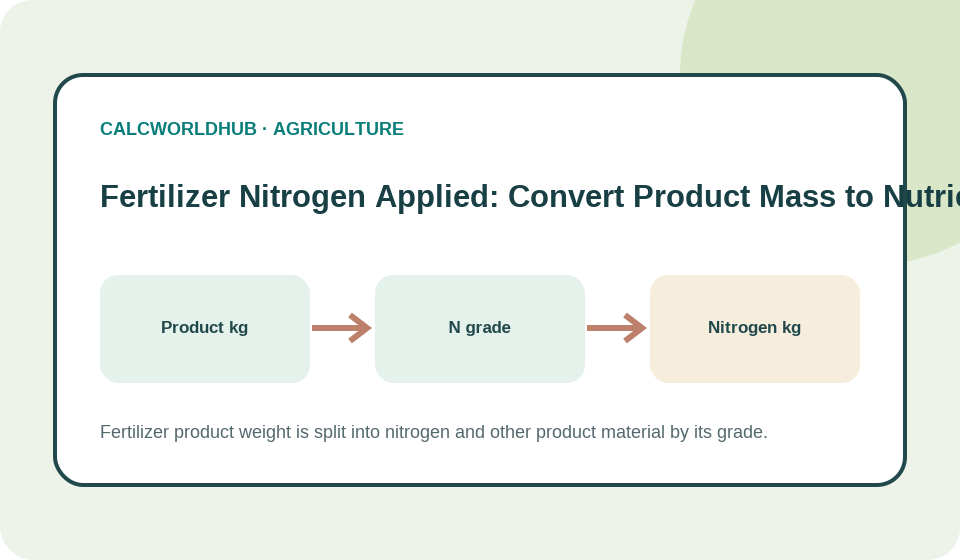

Distinguish product mass from nutrient mass
Enter the mass of fertilizer product in kilograms and the nitrogen percentage shown for that product. A 20% nitrogen grade means 20 kilograms of nitrogen in each 100 kilograms of product under the label convention. The remaining mass consists of other nutrients, carriers, coatings, or formulation components.
The result is the nitrogen contained in the entered amount of product. It is not the same as kilograms of product, and it is not a rate per hectare unless the entered product mass is already tied to a known hectare. Keep the unit basis attached to any result you share.
Use the percentage as a fraction of the product
The calculation is product mass × nitrogen grade ÷ 100. Dividing by 100 converts a percentage such as 18 into the fraction 0.18. Thus, 50 kilograms of a product marked 18% N contains 9 kilograms of nitrogen by this arithmetic.
Do not multiply the fertilizer mass by the grade number without dividing by 100. Also do not add the N, P₂O₅, or K₂O figures unless the question is explicitly about their combined nutrient mass; each label value names a different nutrient expression.
Read a fertilizer analysis in context
The N-P-K numbers communicate nutrient analysis in a standard label sequence. The first number is nitrogen; the next two are phosphate and potash expressed as P₂O₅ and K₂O equivalents. A label such as 8-2-4 therefore does not say that the whole bag is nitrogen, and the nitrogen-only output uses only the first grade.
Check the exact guaranteed analysis and product form. Liquid concentrates may be labeled by mass fraction, volume, or another basis; this calculator asks for kilograms of product and a percentage. If the supplier gives a volume dose or density-dependent concentration, convert to the compatible mass basis before using this simple model.
Do not turn a conversion into an application recommendation
A nutrient mass does not determine whether an application is agronomically appropriate. Crop demand, soil test results, previous applications, timing, placement, environmental rules, and local recommendations all matter. The calculator has no crop selector or soil data, so it cannot select a safe or sufficient nitrogen rate.
Use a local nutrient plan and product label for actual application decisions. For regulated or sensitive settings, follow the governing requirements and advice from a qualified local source. The number here can help reconcile a purchased product quantity with the nitrogen grade, but it does not replace those sources.
Scale the arithmetic without losing the basis
If the product is split over a field, first calculate total kilograms of nitrogen, then divide by the treated area to express kilograms N per hectare. If one product amount covers only part of a field, use that treated area rather than the entire farm. The calculator itself does not ask for area.
Keep the product mass and grade in the same product record. Comparing two fertilizers by bag mass alone can be misleading when their nitrogen grades differ. A smaller amount of a higher-grade product may contain the same nitrogen mass as a larger amount of a lower-grade product.
Check rounding and communication
The underlying multiplication is direct, so a displayed result may be rounded for readability while the exact product is still useful in an inventory calculation. Round only after multiplying; do not round the grade fraction prematurely when the label gives a more precise figure.
When documenting a result, name both quantities, for example “18 kg N in 100 kg of 18% N product.” That wording makes clear that the nutrient mass is a component of the product rather than an additional quantity of fertilizer. It also prevents a product-rate figure from being mistaken for a field rate.
Worked examples
The examples use the nitrogen percentage as a fraction of the fertilizer product mass.
A standard fertilizer quantity
Inputs: Product mass = 80 kg; nitrogen grade = 18%.
Calculation: Nitrogen mass = 80 × 18 ÷ 100 = 14.4 kg N.
The entered product contains 14.4 kg of nitrogen; the calculation does not choose an application rate.
A larger amount at a lower grade
Inputs: Product mass = 125 kg; nitrogen grade = 12.5%.
Calculation: Nitrogen mass = 125 × 12.5 ÷ 100 = 15.625 kg N.
This product amount contains 15.625 kg nitrogen before any field-area conversion.
