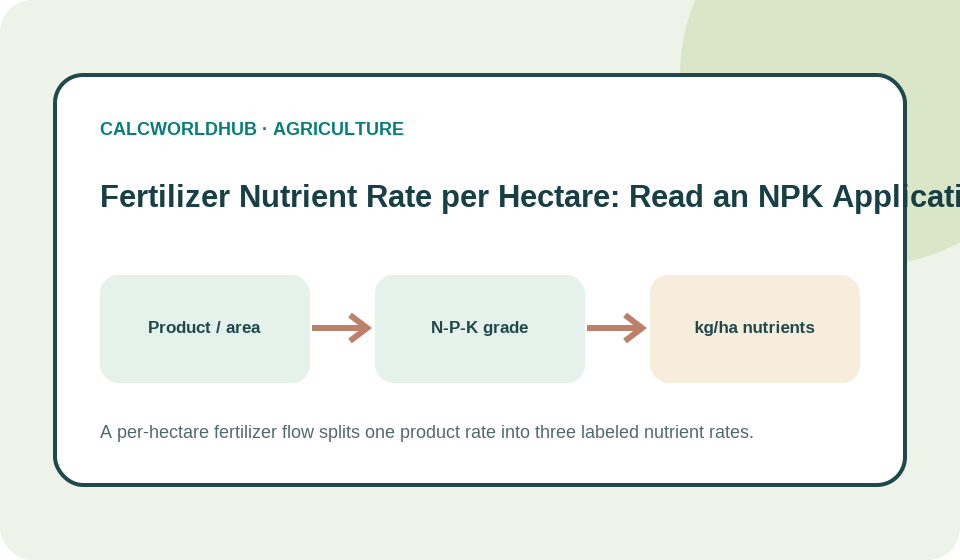

Begin with the amount spread and the area treated
Enter the total fertilizer mass in kilograms and the treated area in hectares. The first step is product rate = product mass ÷ area. If 200 kg covers 5 ha, the product rate is 40 kg/ha. Do not confuse that figure with the amount of any one nutrient.
Use the area that actually received the product. If a headland, buffer, or untreated patch was excluded, the effective treated area may differ from the field’s cadastral area. The calculator does not infer coverage from machine width, travel distance, or application records.
Apply each grade to the product rate
The N, P₂O₅, and K₂O grades are separate percentages of fertilizer product. For each nutrient, multiply the product rate in kg/ha by that grade divided by 100. A 15% nitrogen grade applied at 40 kg product/ha yields 6 kg N/ha.
Use the label convention shown on the product analysis. The second and third N-P-K positions are commonly declared as phosphate (P₂O₅) and potash (K₂O) equivalents, not elemental phosphorus and potassium. Preserve those chemical labels when recording the outputs.
Keep three nutrient results distinct
The calculator returns three per-hectare values, each with its own unit label. They should not be summed and renamed “NPK” without stating what was added. A total mass of the three declared components may be useful for a narrow inventory question, but agronomic recommendations are ordinarily nutrient-specific.
Different grades can produce different output ratios from the same product rate. If the bag is 15-10-20 and the application is 40 kg/ha, the arithmetic gives 6 kg N/ha, 4 kg P₂O₅/ha, and 8 kg K₂O/ha. This describes composition at that rate, not whether the ratio suits the field.
Treat the result as a conversion, not a nutrient plan
The tool does not read soil tests, crop removal, previous manure applications, local regulations, or a crop’s growth stage. It therefore cannot decide whether a result is deficient, excessive, or environmentally appropriate. Use a current local recommendation and the product label before choosing the rate.
If a recommendation is stated as elemental phosphorus or potassium rather than oxide equivalents, convert carefully with a trusted local reference instead of silently treating the numbers as interchangeable. This calculator specifically labels phosphate and potash outputs as P₂O₅ and K₂O.
Check application records and units
For a tank or spreader record, make sure the entered kilograms refer to product mass rather than nutrient mass, and that the area is hectares rather than acres. For liquid products, a volume reading needs a density conversion before it becomes a mass. The calculator does not provide density or unit conversion.
The direct calculation makes a useful audit trail: total product, treated area, product rate, then each nutrient fraction. Preserve the unrounded rate through the grade multiplications and round only the displayed final rates. This avoids small discrepancies when the product mass or area has decimal precision.
Compare products on an equivalent basis
When evaluating two fertilizers, compare nutrient rates per hectare rather than only price per bag or product kilograms per hectare. Products with different grades can deliver different nutrient amounts at the same mass rate. Any economic comparison also needs actual product prices, spreading costs, and the nutrient plan.
If the same product amount is applied over more hectares, each nutrient rate decreases proportionally. Conversely, a smaller treated area increases the per-hectare amount. A sensitivity check can show these arithmetic effects, but field recommendations should be based on agronomy rather than the desire to match a convenient label ratio.
Worked examples
Each example calculates the product rate per hectare before applying the three independent grade percentages.
A five-hectare application
Inputs: Product = 200 kg; area = 5 ha; grade = 15% N, 10% P₂O₅, 20% K₂O.
Calculation: Product rate = 200 ÷ 5 = 40 kg/ha. N = 40 × 15% = 6; P₂O₅ = 40 × 10% = 4; K₂O = 40 × 20% = 8 kg/ha.
The 40 kg/ha product rate supplies three distinct declared nutrient rates: 6, 4, and 8 kg/ha.
A lighter product rate over a smaller field
Inputs: Product = 72 kg; area = 4 ha; grade = 20% N, 10% P₂O₅, 15% K₂O.
Calculation: Product rate = 72 ÷ 4 = 18 kg/ha. N = 18 × 20% = 3.6; P₂O₅ = 18 × 10% = 1.8; K₂O = 18 × 15% = 2.7 kg/ha.
Each nutrient output follows its own grade; the figures are not interchangeable with elemental P or K.
