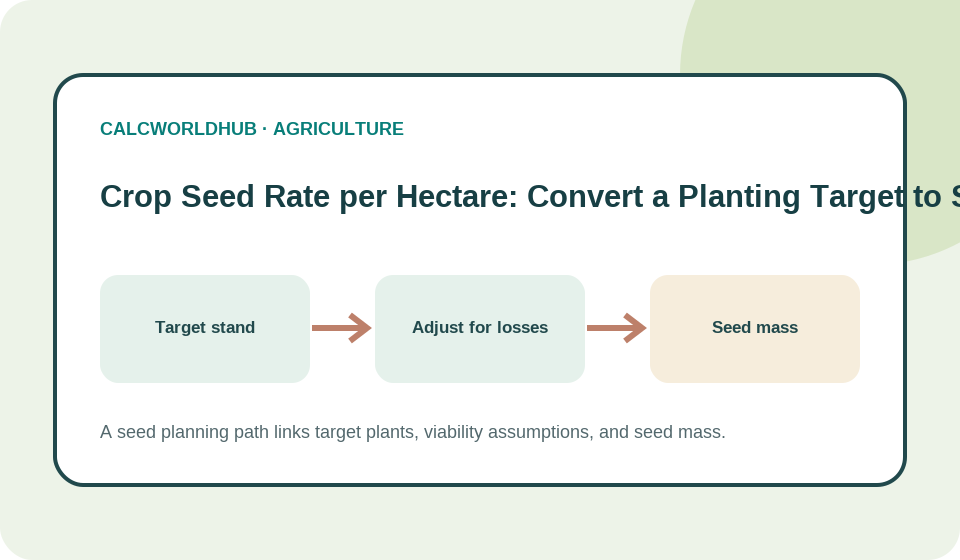

Start with the stand you want to establish
Enter target plant population as plants per hectare. This is the surviving stand goal, not the number of kernels or seeds placed in the soil. Keep the target tied to the crop, planting date, row spacing, and production system you are planning; agronomic recommendations can vary by hybrid, soil, climate, and management.
Germination is the share of tested seeds expected to produce seedlings. Here, establishment is the share of germinated seeds expected to form the target stand in field conditions; it is conditional on germination, not a second pass from the original seed count.
Convert a target into a seed count
The adjusted seed count is target plants divided by the germination fraction and the establishment fraction. A percentage must be converted to a fraction: 90% becomes 0.90. Because each fraction is below one, dividing by both raises the number of seeds required to reach a given plant target.
The model divides the target stand by germination first and by conditional establishment second. Convert each entered percent to a fraction. Some agronomic sources instead report overall establishment from all seeds sown; that figure already includes germination and should be used alone, not multiplied by another germination fraction. If the seeding recommendation already includes expected field losses, do not add a second generic allowance.
Use thousand-seed weight to convert count to kilograms
Thousand-seed weight (TSW) is the mass of 1,000 seeds in grams. Multiply the adjusted seed count by TSW, then divide by 1,000,000 to convert grams per hectare to kilograms per hectare. The factor combines 1,000 seeds per reported TSW and 1,000 grams per kilogram.
Use a representative lot value from the seed label or supplier. A different variety, lot, or treatment can have a different seed size, so a familiar TSW from last year is not automatically a good substitute. If the seed is sold by bag, divide the calculated kilograms by the net kilograms per bag and round the purchasing quantity up separately.
Read the estimate as a planning quantity
The output is seed mass per hectare under the entered assumptions. It does not convert the target to row metres, calibrate a planter, set seed depth, or account for skips and doubles. Those operational checks need the machine, row spacing, field area, and the supplier’s seed specification.
If the target is 50,000 plants/ha and the combined fractions equal 0.72, the implied seed count is about 69,444 seeds/ha. A large adjustment may indicate a percentage entered on the wrong scale or an assumption that needs agronomic review.
Match the model to field conditions
Germination test results are not a guarantee of emergence in a specific field. Soil crusting, moisture, temperature, seed placement, pests, and planting timing can change establishment. The calculator treats both percentages as fixed inputs and has no weather, soil, crop, or seed-lot model behind them.
Use the result alongside local extension guidance and the crop-specific seed label. For high-value seed or a narrow planting window, make the decision from the relevant agronomic recommendation rather than treating a mass conversion as a field prescription. Keep units consistent: plants/ha, percentages, grams per thousand seeds, and kilograms/ha.
Plan the purchase without changing the agronomic target
After estimating kilograms per hectare, multiply by the actual planted area to estimate total seed mass. If the field boundary includes headlands or unplanted strips, use the planted area rather than gross property acreage. Then account for bag sizes and any supplier minimum as purchasing constraints, not as hidden changes to the biological target.
Record the target population, test germination, establishment assumption, TSW, and source lot next to the result. That makes the plan auditable and allows the next season’s field stand to be compared with the inputs that were used, instead of attributing every difference to a single percentage.
Worked examples
The examples separate the desired stand from the extra seed allowance implied by the two entered survival fractions.
A moderate stand target
Inputs: Target = 50,000 plants/ha; germination = 90%; establishment = 80%; TSW = 250 g.
Calculation: Adjusted seed count = 50,000 ÷ 0.90 ÷ 0.80 = 69,444.444 seeds/ha. Seed mass = 69,444.444 × 250 ÷ 1,000,000 = 17.3611 kg/ha.
The estimate is about 17.36 kg of seed per planted hectare before any separate bag-size rounding.
A larger target with a different seed lot
Inputs: Target = 80,000 plants/ha; germination = 95%; establishment = 90%; TSW = 300 g.
Calculation: Adjusted seed count = 80,000 ÷ 0.95 ÷ 0.90 = 93,567.251 seeds/ha. Seed mass = 93,567.251 × 300 ÷ 1,000,000 = 28.0702 kg/ha.
The higher target and heavier seed both raise the required mass; the percentage assumptions also affect the count.
