How to use this calculator
Estimate the asymmetric temperature field around a moving point heat source on a thick workpiece.
- Enter Net power deposited in workpiece (W), Source speed in positive x direction (m/s), Workpiece conductivity (W/m/K), Workpiece diffusivity (m²/s), then complete the remaining labeled fields. Match the units shown beside each field and review the result together with the assumptions below.
- Read the worked example below to check the expected input format and result.
- Compare another scenario by changing one input at a time. Use Reset to return to the starting values.
Rosenthal moving surface point source temperature explained
Estimate the quasi-steady temperature at a point around a moving heat source using the three-dimensional Rosenthal point-source model and the stated source-frame coordinates.
How the calculation works
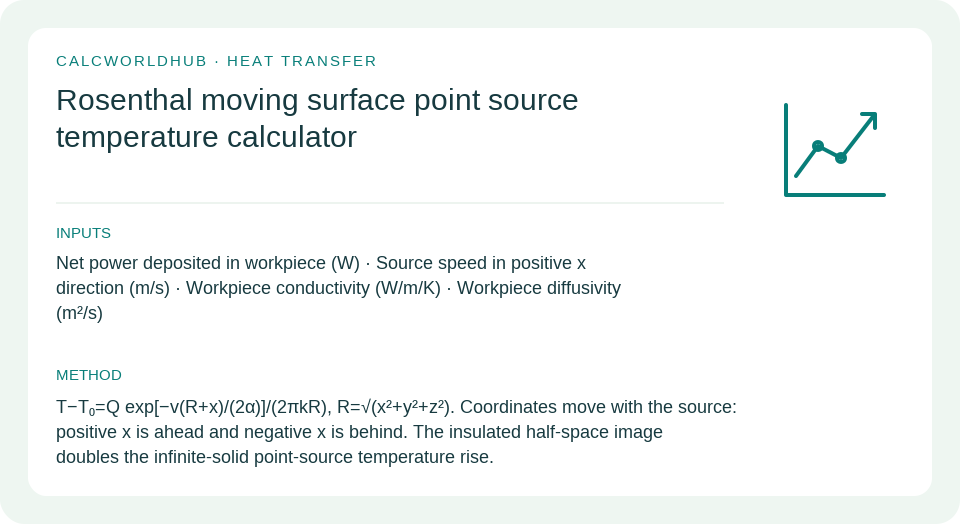
T−T₀=Q exp[−v(R+x)/(2α)]/(2πkR), R=√(x²+y²+z²).
Coordinates move with the source: positive x is ahead and negative x is behind. The insulated half-space image doubles the infinite-solid point-source temperature rise.
Set up the calculation
Q— Net power deposited in workpiece (W)- Net thermal power absorbed by the workpiece, not electrical input before efficiency losses.
v— Source speed in positive x direction (m/s)- Constant heat-source speed in the positive x direction.
k— Workpiece conductivity (W/m/K)- Workpiece thermal conductivity, assumed constant.
alpha— Workpiece diffusivity (m²/s)- Workpiece thermal diffusivity, assumed constant and in m²/s.
x— Source-frame coordinate ahead of source (m)- Signed coordinate relative to the moving source: positive is ahead, negative is behind.
y— Transverse source-frame coordinate (m)- Transverse distance from the source path.
z— Depth below insulated surface (m)- Depth below the modeled surface, using the page’s positive-downward convention.
T0— Remote initial temperature (°C)- Remote workpiece reference temperature in °C; temperature rise has the same numeric value in K.
Limits of this model
Constant properties, thick solid, quasi-steady motion and infinitesimal source. Excludes melt enthalpy, pool convection, finite beam footprint and surface losses; not reliable at the source or within a melt pool.
Check this example
Net power deposited in workpiece (W) = 1000; Source speed in positive x direction (m/s) = 0.005; Workpiece conductivity (W/m/K) = 30; Workpiece diffusivity (m²/s) = 0.000008; Source-frame coordinate ahead of source (m) = -0.01; Transverse source-frame coordinate (m) = 0.005; Depth below insulated surface (m) = 0.002; Remote initial temperature (°C) = 20.
- Quasi-steady local temperature: 325.580178 °C
- Temperature rise above remote workpiece: 305.580178 K
- Source-distance Peclet number: 3.549318
A net 1,000 W source travels at 0.005 m/s over a thick solid with k=30 W/m/K and alpha=8e−6 m²/s. At x=−0.01, y=0.005, z=0.002 m in the moving frame, the model predicts 325.580 °C from a 20 °C background, outside the point-source singularity.
Reading the outputs
Returns local temperature in °C, rise in K and dimensionless source-distance Peclet number.
Frequently asked questions
Is Q the electrical arc power?
Use the power actually absorbed by the workpiece; arc or optical efficiency must be applied beforehand.
Why is the wake hotter than the region ahead?
The moving-frame exponential suppresses heat farther ahead while leaving a longer conductive wake behind.
Can I evaluate exactly at the weld center?
The point source is mathematically singular, so use a distributed source model near its footprint.
How do I use the Rosenthal moving surface point source temperature calculator?
Enter Net power deposited in workpiece (W), Source speed in positive x direction (m/s), Workpiece conductivity (W/m/K), Workpiece diffusivity (m²/s), then complete the remaining labeled fields. Match the units shown beside each field and review the result together with the assumptions below.
What is a worked example of Rosenthal moving surface point source temperature?
Net power deposited in workpiece (W) = 1000; Source speed in positive x direction (m/s) = 0.005; Workpiece conductivity (W/m/K) = 30; Workpiece diffusivity (m²/s) = 0.000008; Source-frame coordinate ahead of source (m) = -0.01; Transverse source-frame coordinate (m) = 0.005; Depth below insulated surface (m) = 0.002; Remote initial temperature (°C) = 20. Quasi-steady local temperature: 325.580178 °C Temperature rise above remote workpiece: 305.580178 K Source-distance Peclet number: 3.549318 A net 1,000 W source travels at 0.005 m/s over a thick solid with k=30 W/m/K and alpha=8e−6 m²/s.
Background or definition reference: IIT NPTEL moving heat sources in conduction.