Sample mean confidence interval lower bound calculator
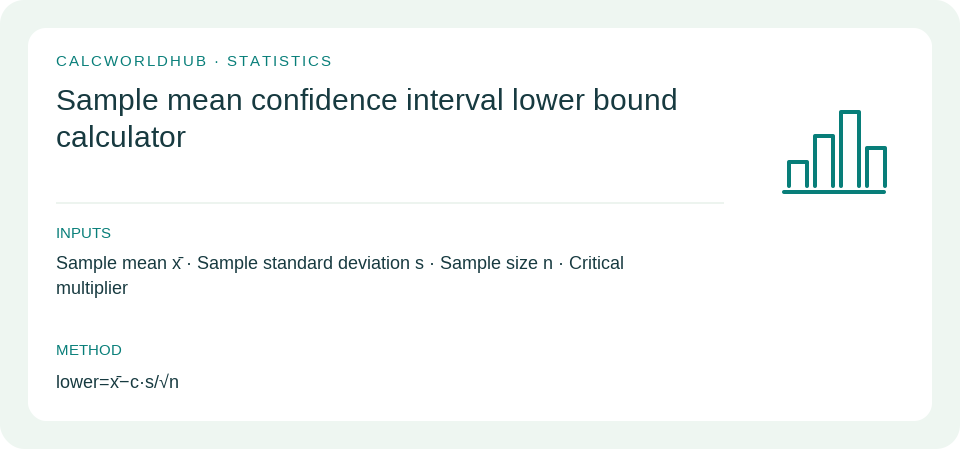
Calculate the lower confidence-limit endpoint by subtracting the supplied margin from the sample mean.
Calculator
How to use this calculator
Calculate the lower confidence-limit endpoint by subtracting the supplied margin from the sample mean.
- Enter Sample mean x̄, Sample standard deviation s, Sample size n, Critical multiplier. Match the units shown beside each field and review the result together with the assumptions below.
- Read the worked example below to check the expected input format and result.
- Compare another scenario by changing one input at a time. Use Reset to return to the starting values.
Sample mean confidence interval lower bound calculator
Calculate the lower confidence-limit endpoint by subtracting the supplied margin from the sample mean.
Inputs and units
- Sample mean x̄: Center of the interval, calculated from the sample and expressed in response units.
- Sample standard deviation s: Sample spread in the same units as each response measurement; it must be nonnegative.
- Sample size n: Number of independent observations contributing to the sample summary; use a positive whole count.
- Critical multiplier: Coverage multiplier for the interval method; pair it with an appropriate t or z procedure.
Formula and method
lower=x̄−c·s/√n
Worked example
For x̄=52, s=8, n=64, c=1.96, the half-width is 1.96 and lower bound=50.04.
Interpreting the result
The lower limit is the left endpoint of the interval, not a minimum observed value. With the example inputs it is 50.04; read it together with the upper limit 53.96 to obtain the full interval.
Assumptions and limits
This endpoint is meaningful only with the matching upper endpoint and a critical multiplier chosen for the stated confidence procedure, sampling design, and degrees of freedom. The calculated margin and mean use the same response units.
Sources and method
- Explains mean confidence intervals and the standard-error term s/√n with a critical multiplier. OpenStax Introductory Statistics 2e: confidence intervals for a mean
Frequently asked questions
Which inputs determine this result?
The visible inputs are Sample mean x̄, Sample standard deviation s, Sample size n, Critical multiplier. Each is used by the displayed formula; the calculator does not use any other hidden measurement.
When does this method apply?
This endpoint is meaningful only with the matching upper endpoint and a critical multiplier chosen for the stated confidence procedure, sampling design, and degrees of freedom. The calculated margin and mean use the same response units.
How do I use the Sample mean confidence interval lower bound calculator?
Enter Sample mean x̄, Sample standard deviation s, Sample size n, Critical multiplier. Match the units shown beside each field and review the result together with the assumptions below.
What is a worked example of Sample mean confidence interval lower bound?
For x̄=52, s=8, n=64, c=1.96, the half-width is 1.96 and lower bound=50.04.
What does the Sample mean confidence interval lower bound calculator calculate?
Calculate the lower confidence-limit endpoint by subtracting the supplied margin from the sample mean.
See the calculation methodology.
Good calculators show their work.
CalcWorldHub is built around clear inputs and visible assumptions. Results are estimates for planning; check official sources or your provider’s terms when exact figures matter.