Sample mean confidence interval upper bound calculator
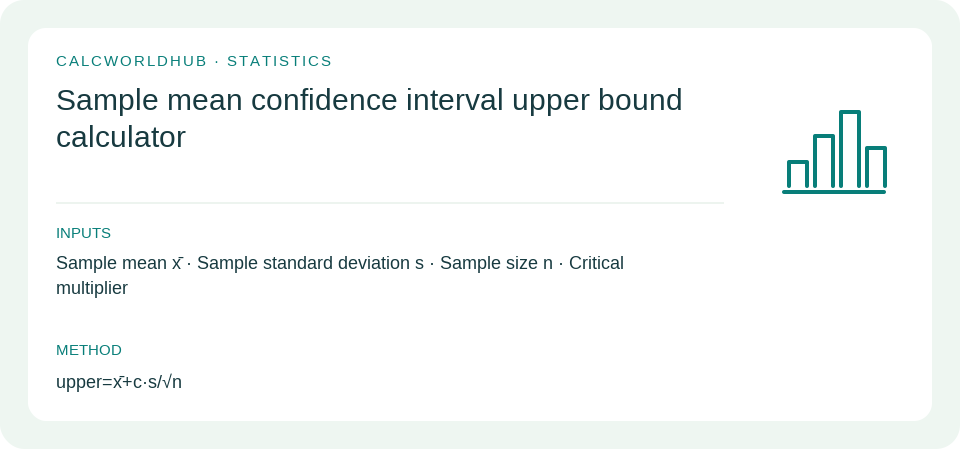
Calculate the upper confidence-limit endpoint by adding the supplied margin to the sample mean.
Calculator
How to use this calculator
Calculate the upper confidence-limit endpoint by adding the supplied margin to the sample mean.
- Enter Sample mean x̄, Sample standard deviation s, Sample size n, Critical multiplier. Match the units shown beside each field and review the result together with the assumptions below.
- Read the worked example below to check the expected input format and result.
- Compare another scenario by changing one input at a time. Use Reset to return to the starting values.
Sample mean confidence interval upper bound calculator
Calculate the upper confidence-limit endpoint by adding the supplied margin to the sample mean.
Inputs and units
- Sample mean x̄: Center of the interval, calculated from the sample and expressed in response units.
- Sample standard deviation s: Sample spread in the same units as each response measurement; it must be nonnegative.
- Sample size n: Number of independent observations contributing to the sample summary; use a positive whole count.
- Critical multiplier: Coverage multiplier for the interval method; pair it with an appropriate t or z procedure.
Formula and method
upper=x̄+c·s/√n
Worked example
For x̄=52, s=8, n=64, c=1.96, the half-width is 1.96 and upper bound=53.96.
Interpreting the result
The upper limit is the right endpoint of the interval, not a maximum observed value. With the example inputs it is 53.96; read it together with the lower limit 50.04 to obtain the full interval.
Assumptions and limits
This endpoint is meaningful only with the matching lower endpoint and a critical multiplier chosen for the stated confidence procedure, sampling design, and degrees of freedom. The calculated margin and mean use the same response units.
Sources and method
- Explains mean confidence intervals and the standard-error term s/√n with a critical multiplier. OpenStax Introductory Statistics 2e: confidence intervals for a mean
Frequently asked questions
Which inputs determine this result?
The visible inputs are Sample mean x̄, Sample standard deviation s, Sample size n, Critical multiplier. Each is used by the displayed formula; the calculator does not use any other hidden measurement.
When does this method apply?
This endpoint is meaningful only with the matching lower endpoint and a critical multiplier chosen for the stated confidence procedure, sampling design, and degrees of freedom. The calculated margin and mean use the same response units.
How do I use the Sample mean confidence interval upper bound calculator?
Enter Sample mean x̄, Sample standard deviation s, Sample size n, Critical multiplier. Match the units shown beside each field and review the result together with the assumptions below.
What is a worked example of Sample mean confidence interval upper bound?
For x̄=52, s=8, n=64, c=1.96, the half-width is 1.96 and upper bound=53.96.
What does the Sample mean confidence interval upper bound calculator calculate?
Calculate the upper confidence-limit endpoint by adding the supplied margin to the sample mean.
See the calculation methodology.
Good calculators show their work.
CalcWorldHub is built around clear inputs and visible assumptions. Results are estimates for planning; check official sources or your provider’s terms when exact figures matter.