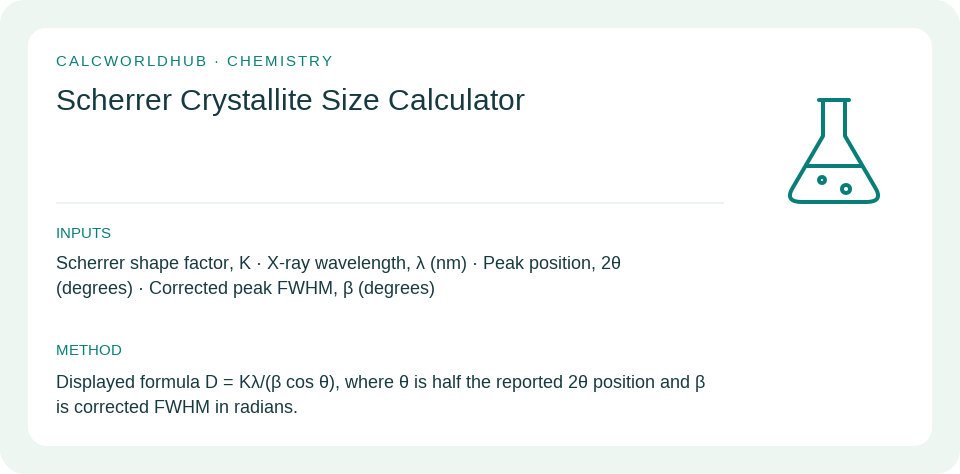
How to use this calculator
Estimate a coherent crystallite size from an X-ray diffraction peak width using the Scherrer equation.
- Enter Scherrer shape factor, K, X-ray wavelength, λ (nm), Peak position, 2θ (degrees), Corrected peak FWHM, β (degrees). Match the units shown beside each field and review the result together with the assumptions below.
- Read the worked example below to check the expected input format and result.
- Compare another scenario by changing one input at a time. Use Reset to return to the starting values.
How this calculation works
The Scherrer relation estimates a characteristic coherent diffraction-domain size from peak broadening. The measured peak width must be corrected for instrumental broadening before it is interpreted as size broadening.
Inputs and units
shapeFactor— Scherrer shape factor, K- Dimensionless shape factor appropriate to the chosen breadth definition and domain shape.
wavelengthNm— X-ray wavelength, λ (nm)- Monochromatic X-ray wavelength.
twoThetaDeg— Peak position, 2θ (degrees)- Measured diffraction angle on the instrument's 2θ axis.
fwhmDeg— Corrected peak FWHM, β (degrees)- Peak breadth after instrumental broadening correction.
Formula
D = Kλ/(β cos θ), where θ is half the reported 2θ position and β is corrected FWHM in radians.
Method
Enter the shape factor K, X-ray wavelength in nm, diffraction peak position as 2θ in degrees, and instrument-corrected peak FWHM β in degrees. The width is converted to radians internally.
Worked example
For K = 0.90, λ = 0.15406 nm, 2θ = 30°, and corrected β = 0.20°, the Scherrer estimate is about 41.1227 nm.
Assumptions and limits
This is an approximate coherent-domain size, not necessarily a particle or grain diameter. Strain, defects, overlapping peaks, profile shape, instrumental broadening, and crystallite shape affect the result; use a suitable line-profile analysis for quantitative characterization.
Frequently asked questions
What size does the Scherrer equation estimate?
It estimates a coherent diffraction-domain size along the direction associated with the selected reflection.
Why correct the peak width?
Instrument broadening also widens a measured peak; it should be removed using an appropriate instrument-profile method before applying this estimate.
Is the estimate a particle diameter?
Not necessarily. A particle can contain several coherent domains, and strain or defects can contribute to peak width.
How do I use the Scherrer Crystallite Size Calculator?
Enter Scherrer shape factor, K, X-ray wavelength, λ (nm), Peak position, 2θ (degrees), Corrected peak FWHM, β (degrees). Match the units shown beside each field and review the result together with the assumptions below.
What is a worked example of Scherrer Crystallite Size?
For K = 0.90, λ = 0.15406 nm, 2θ = 30°, and corrected β = 0.20°, the Scherrer estimate is about 41.1227 nm.
Reference: Patterson’s original Scherrer-equation derivation for X-ray particle-size determination. See our calculation methodology.