Schwarzschild radius calculator
Estimate the characteristic event-horizon radius for an idealized spherical mass.
inputs.
Calculator
How to use this calculator
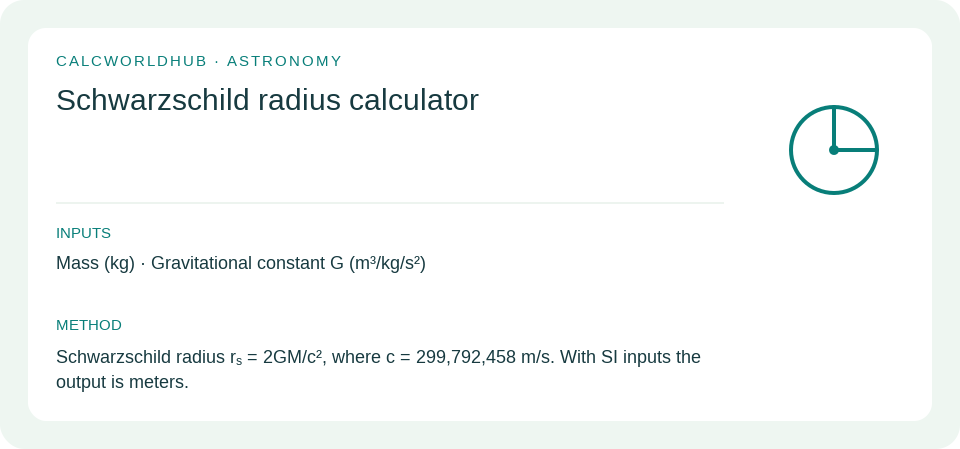
Calculate the Schwarzschild radius rₛ = 2GM/c² for an idealized nonrotating, uncharged mass.
- Enter Mass (kg), Gravitational constant G (m³/kg/s²). Match the units shown beside each field and review the result together with the assumptions below.
- Read the worked example below to check the expected input format and result.
- Compare another scenario by changing one input at a time. Use Reset to return to the starting values.
Estimate the Schwarzschild radius of a spherical mass
Calculate the radius at which the Schwarzschild solution places an event horizon for an idealized nonrotating, uncharged mass.
Inputs and units
- Mass (kg): Mass parameter M in kilograms.
- Gravitational constant G (m³/kg/s²): Use the physical constant appropriate to the unit system; the standard SI value is about 6.6743×10⁻¹¹.
Formula and method
Schwarzschild radius rₛ = 2GM/c², where c = 299,792,458 m/s. With SI inputs the output is meters.
Worked example
For Earth mass 5.97×10²⁴ kg and G = 6.6743×10⁻¹¹ m³/kg/s², rₛ ≈ 0.00887 m, or about 8.87 mm.
Interpreting the result
The value is a characteristic radius from an idealized general-relativity solution. It does not mean Earth is close to becoming a black hole or that matter can be compressed by this calculator.
Assumptions and limits
Assumes a static, spherical, uncharged mass in vacuum. Rotation, charge, surrounding matter, and astrophysical formation are outside this formula; the result is not a prediction that an object will collapse.
Method references
Frequently asked questions
Why is Earth’s value so small?
The Schwarzschild radius is proportional to mass; Earth’s mass corresponds to a radius of only a few millimeters.
Does this calculate black-hole formation?
No. It evaluates a radius for an idealized mass; formation depends on physical processes not represented here.
How do I use the Schwarzschild radius calculator?
Enter Mass (kg), Gravitational constant G (m³/kg/s²). Match the units shown beside each field and review the result together with the assumptions below.
What is a worked example of Schwarzschild radius?
For Earth mass 5.97×10²⁴ kg and G = 6.6743×10⁻¹¹ m³/kg/s², rₛ ≈ 0.00887 m, or about 8.87 mm.
What does the Schwarzschild radius calculator calculate?
Calculate the Schwarzschild radius rₛ = 2GM/c² for an idealized nonrotating, uncharged mass.
Good calculators show their work.
CalcWorldHub is built around clear inputs and visible assumptions. Results are estimates for planning; check official sources or your provider’s terms when exact figures matter.