How to use this calculator
Calculate useful reversible work from a fixed mass of ideal gas while accounting for displacement of the surrounding atmosphere.
- Enter Gas temperature (K), Gas absolute pressure (kPa), Environment temperature (K), Environment absolute pressure (kPa), then complete the remaining labeled fields. Match the units shown beside each field and review the result together with the assumptions below.
- Read the worked example below to check the expected input format and result.
- Compare another scenario by changing one input at a time. Use Reset to return to the starting values.
Sealed ideal gas nonflow availability explained
A numerical walkthrough
Gas temperature (K) = 400; Gas absolute pressure (kPa) = 600; Environment temperature (K) = 300; Environment absolute pressure (kPa) = 100; cp (kJ/kg/K) = 1.005; Specific gas constant (kJ/kg/K) = 0.287.
- Specific nonflow exergy: 72.367679 kJ/kg
- Current specific volume: 0.191333 m³/kg
- Entropy above dead state: -0.225114 kJ/kg/K
A sealed ideal-gas state at 400 K and 600 kPa has 72.3677 kJ/kg nonflow availability relative to 300 K and 100 kPa. Its specific volume is 0.191333 m³/kg; environmental displacement work is part of the availability balance.
The model behind the numbers
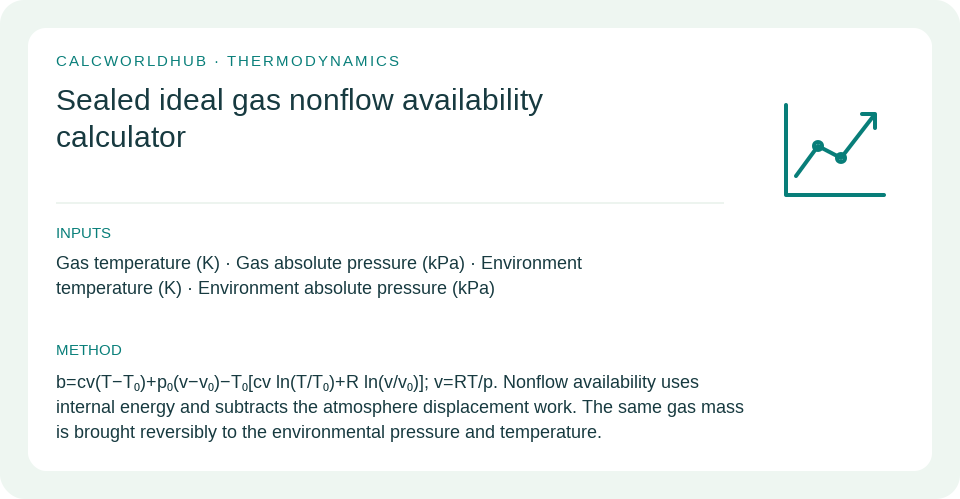
b=cv(T−T₀)+p₀(v−v₀)−T₀[cv ln(T/T₀)+R ln(v/v₀)]; v=RT/p.
Nonflow availability uses internal energy and subtracts the atmosphere displacement work. The same gas mass is brought reversibly to the environmental pressure and temperature.
What to enter
T— Gas temperature (K)- Gas temperature (K). Enter the value for this state; the units shown are used without an unstated conversion.
p— Gas absolute pressure (kPa)- Gas absolute pressure (kPa). Enter the value for this state; the units shown are used without an unstated conversion.
T0— Environment temperature (K)- Environment temperature (K). Enter the value for this state; the units shown are used without an unstated conversion.
p0— Environment absolute pressure (kPa)- Environment absolute pressure (kPa). Enter the value for this state; the units shown are used without an unstated conversion.
cp— cp (kJ/kg/K)- cp (kJ/kg/K). Enter the value for this state; the units shown are used without an unstated conversion.
R— Specific gas constant (kJ/kg/K)- Specific gas constant (kJ/kg/K). Enter the value for this state; the units shown are used without an unstated conversion.
Interpreting the result
Fixed composition, ideal gas, constant cp and no kinetic or chemical exergy. A rigid tank by itself cannot realize every reversible path represented by this upper bound.
Reading the outputs
Returns nonnegative specific closed-system exergy, current specific volume and signed entropy difference.
Frequently asked questions
Why does this differ from stream exergy?
A flowing stream includes inlet and outlet flow work; a closed mass displaces its surroundings differently.
Must a subambient tank have zero exergy?
No. A pressure difference below ambient is also a source of useful reversible work.
Can I multiply by gas mass?
Yes. Specific exergy times fixed gas mass gives total nonflow exergy.
How do I use the Sealed ideal gas nonflow availability calculator?
Enter Gas temperature (K), Gas absolute pressure (kPa), Environment temperature (K), Environment absolute pressure (kPa), then complete the remaining labeled fields. Match the units shown beside each field and review the result together with the assumptions below.
What is a worked example of Sealed ideal gas nonflow availability?
Gas temperature (K) = 400; Gas absolute pressure (kPa) = 600; Environment temperature (K) = 300; Environment absolute pressure (kPa) = 100; cp (kJ/kg/K) = 1.005; Specific gas constant (kJ/kg/K) = 0.287. Specific nonflow exergy: 72.367679 kJ/kg Current specific volume: 0.191333 m³/kg Entropy above dead state: -0.225114 kJ/kg/K A sealed ideal-gas state at 400 K and 600 kPa has 72.3677 kJ/kg nonflow availability relative to 300 K and 100 kPa. Its specific volume is 0.191333 m³/kg; environmental displacement work is part of the availability balance.
Read our calculation methodology.