How to use this calculator
Account for temperature, pressure, motion and elevation when evaluating the reversible work potential of an ideal-gas stream.
- Enter Stream temperature (K), Stream absolute pressure (kPa), Dead-state temperature (K), Dead-state absolute pressure (kPa), then complete the remaining labeled fields. Match the units shown beside each field and review the result together with the assumptions below.
- Read the worked example below to check the expected input format and result.
- Compare another scenario by changing one input at a time. Use Reset to return to the starting values.
Ideal gas stream physical exergy explained
Account for temperature, pressure, motion and elevation when evaluating the reversible work potential of an ideal-gas stream.
How the calculation works
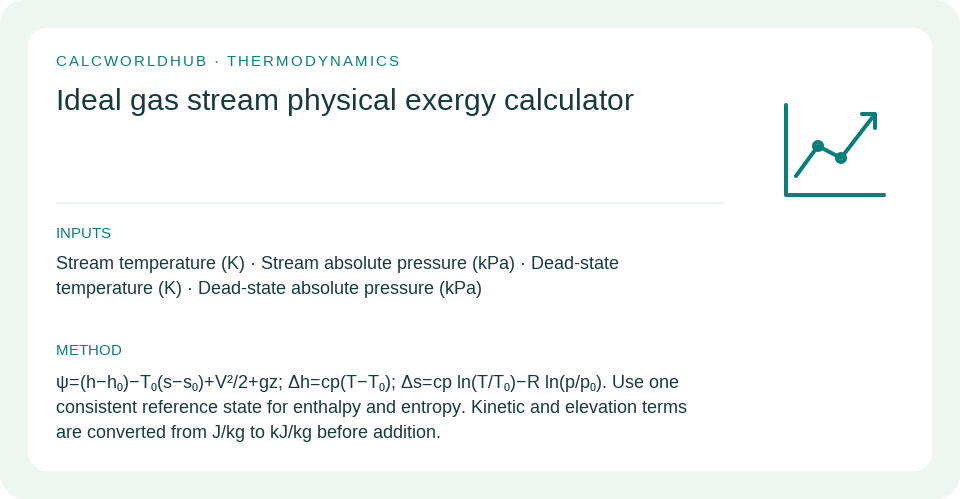
ψ=(h−h₀)−T₀(s−s₀)+V²/2+gz; Δh=cp(T−T₀); Δs=cp ln(T/T₀)−R ln(p/p₀).
Use one consistent reference state for enthalpy and entropy. Kinetic and elevation terms are converted from J/kg to kJ/kg before addition.
Set up the calculation
T— Stream temperature (K)- Absolute stream temperature for the evaluated flowing state; it enters both the enthalpy difference and logarithmic entropy term.
p— Stream absolute pressure (kPa)- Stream absolute pressure, compared with dead-state pressure p0; gauge pressure cannot be substituted.
T0— Dead-state temperature (K)- Absolute dead-state reference temperature used for both the thermal entropy weighting and enthalpy reference.
p0— Dead-state absolute pressure (kPa)- Dead-state absolute pressure paired with T0 in the ideal-gas entropy difference.
cp— Specific heat cp (kJ/kg/K)- Constant-pressure heat capacity assumed constant from T0 to T; it must exceed the entered specific gas constant R.
R— Specific gas constant (kJ/kg/K)- Specific gas constant for the same ideal gas and mass basis as cp.
v— Stream speed (m/s)- Stream speed relative to the control volume; its kinetic contribution is v²/2.
z— Elevation above dead-state datum (m)- Signed elevation relative to the dead-state datum; positive height adds gravitational potential exergy.
Limits of this model
Physical flow exergy only; no chemical composition exergy. Signed elevation datum and subambient pressure can produce negative terms; use a complete control-volume balance.
Check this example
Stream temperature (K) = 450; Stream absolute pressure (kPa) = 500; Dead-state temperature (K) = 300; Dead-state absolute pressure (kPa) = 100; Specific heat cp (kJ/kg/K) = 1.005; Specific gas constant (kJ/kg/K) = 0.287; Stream speed (m/s) = 20; Elevation above dead-state datum (m) = 0.
- Specific stream exergy: 167.274874 kJ/kg
- Enthalpy above dead state: 150.75 kJ/kg
- Entropy above dead state: -0.054416 kJ/kg/K
An ideal gas stream at 450 K and 500 kPa enters a 300 K, 100 kPa environment at 20 m/s. The model assigns 167.275 kJ/kg physical flow exergy, including the 0.2 kJ/kg kinetic contribution.
Reading the outputs
Specific stream exergy, enthalpy difference and entropy difference refer to the prescribed ambient pressure and temperature.
Frequently asked questions
Why can the pressure term be negative?
A stream below ambient pressure requires work to restore to ambient; stream exergy need not be a closed-system stored availability.
Is this gas storage exergy?
No. Flow work is included through enthalpy; a sealed tank requires a nonflow model.
Must the reference gas have the same composition?
Yes. Otherwise chemical exergy must also be considered.
How do I use the Ideal gas stream physical exergy calculator?
Enter Stream temperature (K), Stream absolute pressure (kPa), Dead-state temperature (K), Dead-state absolute pressure (kPa), then complete the remaining labeled fields. Match the units shown beside each field and review the result together with the assumptions below.
What is a worked example of Ideal gas stream physical exergy?
Stream temperature (K) = 450; Stream absolute pressure (kPa) = 500; Dead-state temperature (K) = 300; Dead-state absolute pressure (kPa) = 100; Specific heat cp (kJ/kg/K) = 1.005; Specific gas constant (kJ/kg/K) = 0.287; Stream speed (m/s) = 20; Elevation above dead-state datum (m) = 0. Specific stream exergy: 167.274874 kJ/kg Enthalpy above dead state: 150.75 kJ/kg Entropy above dead state: -0.054416 kJ/kg/K An ideal gas stream at 450 K and 500 kPa enters a 300 K, 100 kPa environment at 20 m/s. The model assigns 167.275 kJ/kg physical flow exergy, including the 0.2 kJ/kg kinetic contribution.
Read our calculation methodology.