How to use this calculator
Estimate a second derivative from function values at equally spaced points on both sides of x.
- Enter f(x−h), f(x), f(x+h), Step h. Match the units shown beside each field and review the result together with the assumptions below.
- Read the worked example below to check the expected input format and result.
- Compare another scenario by changing one input at a time. Use Reset to return to the starting values.
How Second central difference derivative calculator works
Estimate a second derivative from function values at equally spaced points on both sides of x.
Inputs and units
- f(x−h): f(x−h) is the value one step left of x.
- f(x): f(x) is the center value.
- f(x+h): f(x+h) is the value one step right of x.
- Step h: h is a nonzero signed spacing; the denominator uses h².
Formula and method
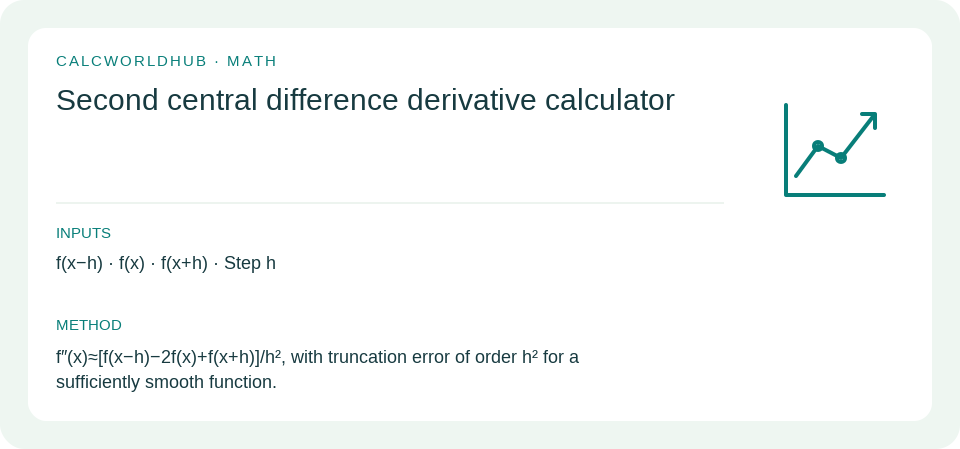
f″(x)≈[f(x−h)−2f(x)+f(x+h)]/h², with truncation error of order h² for a sufficiently smooth function.
Worked example
For f(x)=x² at x=2 and h=0.1, the values 3.61, 4, and 4.41 give (3.61−8+4.41)/0.01=2.
Interpreting the result
The estimate has units of function output divided by x-units squared. For a quadratic, the centered formula is exact apart from rounding.
Assumptions and limits
h=0 is invalid. Very small h can amplify floating-point cancellation, while large h can increase truncation error; a useful step balances both.
Sources and method
- Three-point forward first-derivative and central second-derivative stencils and their truncation orders are derived. UC Berkeley: numerical differentiation
Frequently asked questions
Why are values needed on both sides?
The symmetric stencil cancels the leading odd-order error terms.
Can h be negative?
Yes; the squared denominator and swapped side values leave the same central estimate.
How do I use the Second central difference derivative calculator?
Enter f(x−h), f(x), f(x+h), Step h. Match the units shown beside each field and review the result together with the assumptions below.
What is a worked example of Second central difference derivative?
For f(x)=x² at x=2 and h=0.1, the values 3.61, 4, and 4.41 give (3.61−8+4.41)/0.01=2.
What does the Second central difference derivative calculator calculate?
Estimate a second derivative from function values at equally spaced points on both sides of x.