Second-order reaction concentration calculator
Estimate remaining concentration for a single-reactant second-order reaction. Enter your values below to see the result and method.
inputs.
Related calculators
These tools cover nearby questions while keeping this page focused on its own calculation.
How to use this calculator
Estimate remaining concentration for a single-reactant second-order reaction.
- Enter Initial concentration (mol/L), Second-order rate constant (L/mol·s), Time (s). Match the units shown beside each field and review the result together with the assumptions below.
- Read the worked example below to check the expected input format and result.
- Compare another scenario by changing one input at a time. Use Reset to return to the starting values.
Set the chemical conditions and units
Estimate remaining concentration for a single-reactant second-order reaction.
Inputs and units
Use the units printed beside each field. These values are Initial concentration (mol/L), Second-order rate constant (L/mol·s), Time (s).
- Initial concentration (mol/L): Reactant concentration at t=0 for the single-reactant second-order model.
- Second-order rate constant (L/mol·s): Rate constant for rate proportional to concentration squared; units must match mol/L and seconds.
- Time (s): Elapsed reaction time from the initial concentration, in seconds.
Equation and worked example
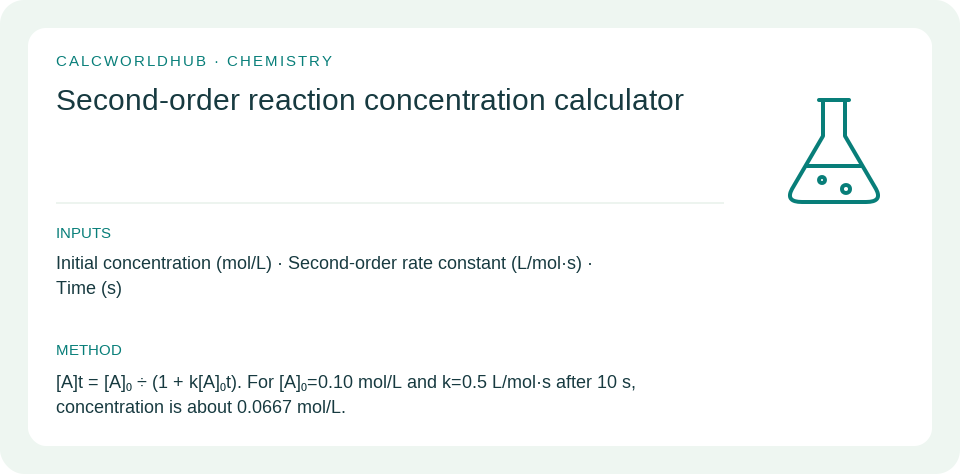
[A]t = [A]₀ ÷ (1 + k[A]₀t).
For [A]₀=0.10 mol/L and k=0.5 L/mol·s after 10 s, concentration is about 0.0667 mol/L.
Using the result
The output is remaining concentration from the integrated single-reactant law with rate proportional to [A]²; other reaction orders require different integrated laws.
Assumptions and limitations
Uses the integrated law for a single reactant with rate proportional to [A]²; other reaction orders need another model.
Method reference: OpenStax Chemistry 2e, Integrated Rate Laws.
Frequently asked questions
Which units keep the second-order concentration equation consistent?
Use concentration in mol/L, k in L/(mol·s), and time in seconds so k[A]₀t is dimensionless.
When does this second-order concentration equation apply?
It applies to a single-reactant rate law −d[A]/dt = k[A]² under the stated model assumptions. A different reaction order requires its own integrated equation.
When should I use a zero-order concentration model?
A zero-order law applies when concentration falls at a constant rate. This page uses the integrated law for one reactant whose rate is proportional to [A]².
How do I use the Second-order reaction concentration calculator?
Enter Initial concentration (mol/L), Second-order rate constant (L/mol·s), Time (s). Match the units shown beside each field and review the result together with the assumptions below.
What is a worked example of Second-order reaction concentration?
[A]t = [A]₀ ÷ (1 + k[A]₀t). For [A]₀=0.10 mol/L and k=0.5 L/mol·s after 10 s, concentration is about 0.0667 mol/L.
Read the calculation methodology and privacy policy.