Second-order reaction half-life calculator
Calculate half-life for a second-order reaction involving one reactant. Enter your values below to see the result and method.
inputs.
Related calculators
These tools cover nearby questions while keeping this page focused on its own calculation.
How to use this calculator
Calculate half-life for a second-order reaction involving one reactant.
- Enter Initial concentration (mol/L), Second-order rate constant (L/mol·s). Match the units shown beside each field and review the result together with the assumptions below.
- Read the worked example below to check the expected input format and result.
- Compare another scenario by changing one input at a time. Use Reset to return to the starting values.
Set the chemical conditions and units
Calculate half-life for a second-order reaction involving one reactant.
Inputs and units
Use the units printed beside each field. These values are Initial concentration (mol/L), Second-order rate constant (L/mol·s).
- Initial concentration (mol/L): Reactant concentration at the start of the second-order interval.
- Second-order rate constant (L/mol·s): Rate constant for the integrated single-reactant second-order law, in L·mol⁻¹·s⁻¹.
Equation and worked example
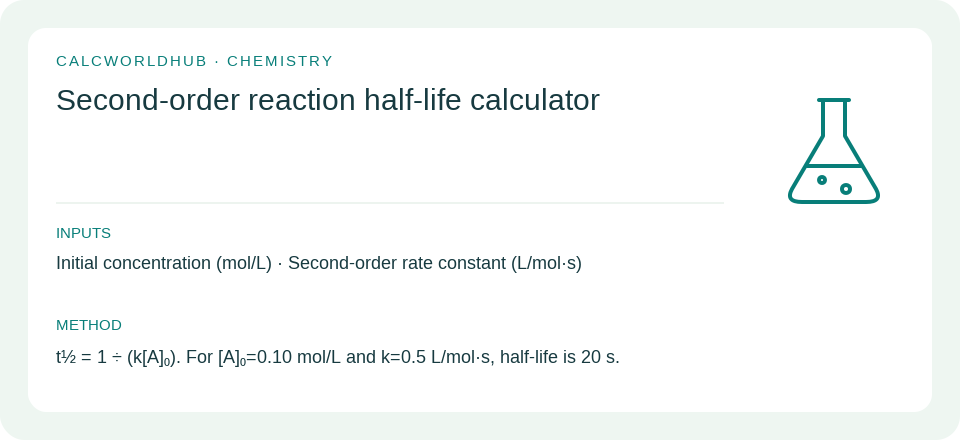
t½ = 1 ÷ (k[A]₀).
For [A]₀=0.10 mol/L and k=0.5 L/mol·s, half-life is 20 s.
Using the result
For this single-reactant model, t½=1/(k[A]₀); doubling initial concentration halves predicted half-life. First-order half-life is independent of [A]₀.
Assumptions and limitations
Assumes the integrated second-order single-reactant model; unlike first-order half-life, it depends on initial concentration.
Method reference: OpenStax Chemistry 2e, Integrated Rate Laws.
Frequently asked questions
Which inputs determine second-order half-life?
Enter [A]₀ in mol/L and k in L/(mol·s); these units make the calculated half-life seconds.
Why does second-order half-life depend on initial concentration?
For this model, t₁/₂ = 1/(k[A]₀). Doubling [A]₀ halves the predicted half-life, unlike a first-order half-life.
How does second-order half-life depend on concentration?
For this single-reactant model, t½=1/(k[A]₀); doubling initial concentration halves predicted half-life. First-order half-life is independent of [A]₀.
How do I use the Second-order reaction half-life calculator?
Enter Initial concentration (mol/L), Second-order rate constant (L/mol·s). Match the units shown beside each field and review the result together with the assumptions below.
What is a worked example of Second-order reaction half-life?
t½ = 1 ÷ (k[A]₀). For [A]₀=0.10 mol/L and k=0.5 L/mol·s, half-life is 20 s.
Read the calculation methodology and privacy policy.