First-order reaction half-life calculator
Find the half-life of a first-order process from its rate constant. Enter your values below to see the result and method.
inputs.
Related calculators
These first-order pages connect half-life, concentration change, rate constant, and target time using the same kinetic assumption.
How to use this calculator
Free First-order reaction half-life calculator. Find the half-life of a first-order process from its rate constant. Formula, example, and assumptions explained.
- Enter First-order rate constant k (s⁻¹). Match the units shown beside each field and review the result together with the assumptions below.
- Read the worked example below to check the expected input format and result.
- Compare another scenario by changing one input at a time. Use Reset to return to the starting values.
Set the chemical conditions and units
Find the half-life of a first-order process from its rate constant.
Inputs and units
Enter k in inverse seconds (s⁻¹); the returned half-life is in seconds.
- First-order rate constant k (s⁻¹): Positive first-order rate constant. With k in s⁻¹, the calculated half-life is in seconds.
Equation and worked example
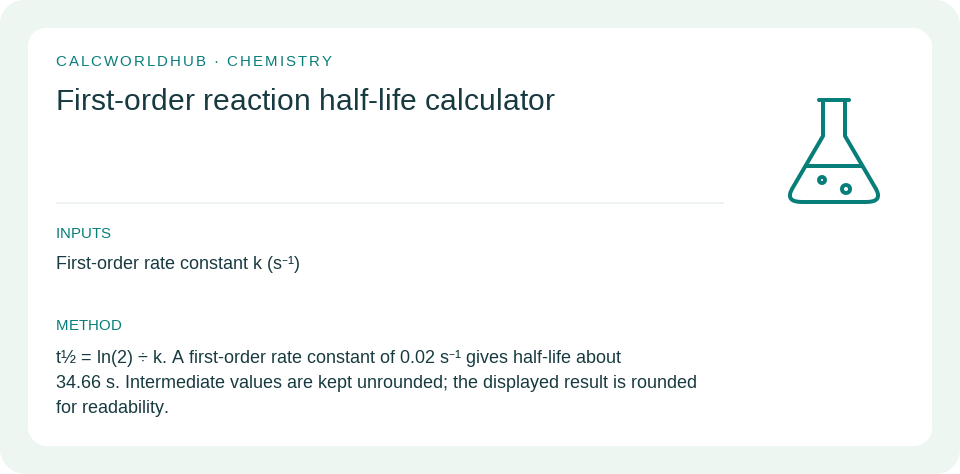
t½ = ln(2) ÷ k.
A first-order rate constant of 0.02 s⁻¹ gives half-life about 34.66 s.
Intermediate values are kept unrounded; the displayed result is rounded for readability.
Using the result
The output is the time for concentration to fall by one half under first-order kinetics; it does not depend on the initial concentration.
Assumptions and limitations
First-order half-life is independent of starting concentration when the model applies.
Frequently asked questions
How is a first-order half-life calculated?
Use t½=ln(2)/k. A rate constant of 0.02 s⁻¹ gives 34.66 s.
Does the starting concentration affect this half-life?
No. Under first-order kinetics, the half-life is independent of starting concentration.
What units should k use?
Use an inverse-time unit. The result has the corresponding time unit: s⁻¹ produces seconds, while min⁻¹ produces minutes.
How do I use the First-order reaction half-life calculator?
Enter First-order rate constant k (s⁻¹). Match the units shown beside each field and review the result together with the assumptions below.
What is a worked example of First-order reaction half-life?
t½ = ln(2) ÷ k. A first-order rate constant of 0.02 s⁻¹ gives half-life about 34.66 s. Intermediate values are kept unrounded; the displayed result is rounded for readability.
Read the calculation methodology and privacy policy.