First-order reaction time to target concentration calculator
Calculate how long a first-order process takes to reach a target concentration. Enter your values below to see the result and method.
inputs.
Related calculators
Use the linked first-order tools to connect concentration, rate constant, half-life, and elapsed time.
How to use this calculator
Calculate how long a first-order process takes to reach a target concentration.
- Enter Initial concentration (mol/L), Target concentration (mol/L), Rate constant k (s⁻¹). Match the units shown beside each field and review the result together with the assumptions below.
- Read the worked example below to check the expected input format and result.
- Compare another scenario by changing one input at a time. Use Reset to return to the starting values.
Set the chemical conditions and units
Calculate how long a first-order process takes to reach a target concentration.
Inputs and units
Use initial and target concentrations in the same units, with a positive first-order rate constant k in s⁻¹; the answer is seconds.
- Initial concentration (mol/L): Concentration at the start of the interval.
- Target concentration (mol/L): Desired remaining concentration; for first-order decay it must be positive and below the initial value.
- Rate constant k (s⁻¹): Positive first-order rate constant; an input in s⁻¹ produces an answer in seconds.
Equation and worked example
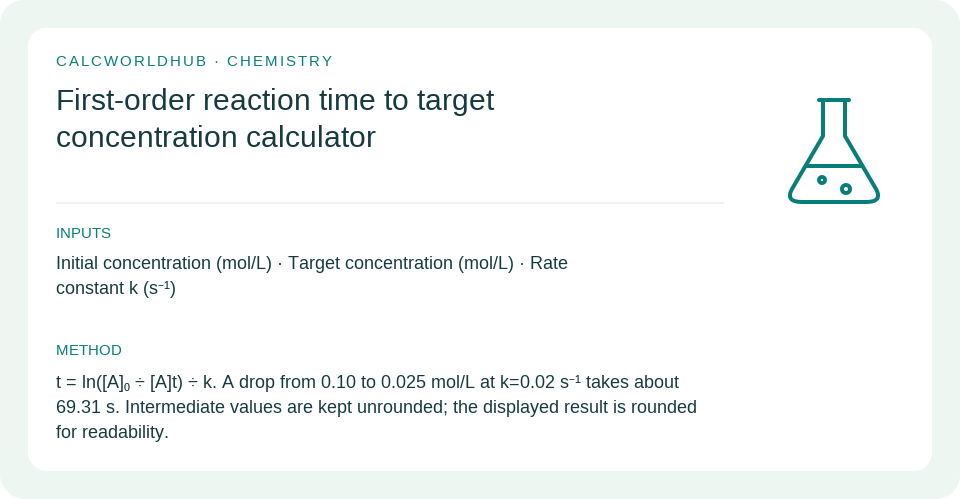
t = ln([A]₀ ÷ [A]t) ÷ k.
A drop from 0.10 to 0.025 mol/L at k=0.02 s⁻¹ takes about 69.31 s.
Intermediate values are kept unrounded; the displayed result is rounded for readability.
Using the result
The result is elapsed time in the first-order decay model. It is nonnegative only when the target concentration does not exceed the starting value.
Assumptions and limitations
Target concentration must be positive and no greater than the initial value; rate constant uses inverse seconds.
Frequently asked questions
How long does a first-order reaction take to reach a target concentration?
Use t=ln(C₀/Ct)/k for positive concentrations with Ct≤C₀ and k>0. The result is zero when the target equals the initial concentration.
Can the target concentration exceed the starting concentration?
Not for a decaying first-order process using this formula. A target above C₀ gives negative time and is outside the modeled decay direction.
What units does the time use?
Time is the reciprocal of the rate-constant unit. For k in s⁻¹, the result is seconds.
How do I use the First-order reaction time to target concentration calculator?
Enter Initial concentration (mol/L), Target concentration (mol/L), Rate constant k (s⁻¹). Match the units shown beside each field and review the result together with the assumptions below.
What is a worked example of First-order reaction time to target concentration?
t = ln([A]₀ ÷ [A]t) ÷ k. A drop from 0.10 to 0.025 mol/L at k=0.02 s⁻¹ takes about 69.31 s. Intermediate values are kept unrounded; the displayed result is rounded for readability.
Read the calculation methodology and privacy policy.