How to use this calculator
Evaluate the transient output of a canonical second-order closed-loop system without assuming it is underdamped.
- Enter Natural angular frequency (rad/s), Damping ratio, DC gain (output/input), Step magnitude (input units), then complete the remaining labeled fields. Match the units shown beside each field and review the result together with the assumptions below.
- Read the worked example below to check the expected input format and result.
- Compare another scenario by changing one input at a time. Use Reset to return to the starting values.
Second order step response across damping regimes explained
Evaluate the transient output of a canonical second-order closed-loop system without assuming it is underdamped.
How the calculation works
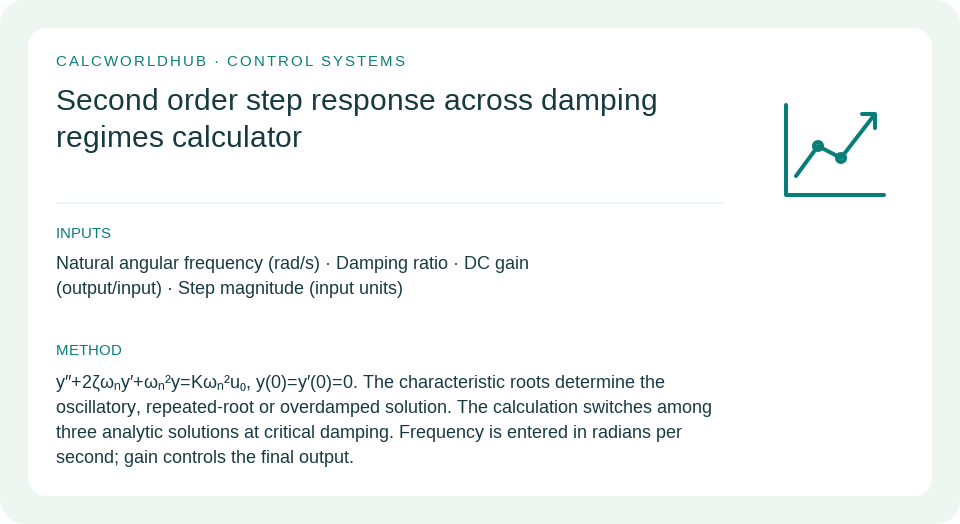
y″+2ζωₙy′+ωₙ²y=Kωₙ²u₀, y(0)=y′(0)=0. The characteristic roots determine the oscillatory, repeated-root or overdamped solution.
The calculation switches among three analytic solutions at critical damping. Frequency is entered in radians per second; gain controls the final output.
Set up the calculation
w— Natural angular frequency (rad/s)- Undamped natural frequency, not cycles per second.
z— Damping ratio- Zero is undamped; one is critical damping.
K— DC gain (output/input)- Final output change per unit step.
u— Step magnitude (input units)- Constant input applied from time zero.
t— Elapsed time (s)- Evaluation time from the initial zero state.
Limits of this model
No numerator zero, delay or nonlinear actuator. An undamped response oscillates indefinitely.
Check this example
Natural angular frequency (rad/s) = 4; Damping ratio = 0.45; DC gain (output/input) = 1.5; Step magnitude (input units) = 2; Elapsed time (s) = 0.8.
- Output: 3.582007 output units
- Output rate: 0.891763 output units/s
- DC target: 3 output units
A loop with natural frequency 4 rad/s and damping 0.45 tracks a two-unit step with gain 1.5; inspect its position and velocity at 0.8 seconds.
Reading the outputs
The output rate reveals whether the response is still rising or has passed a peak; DC target is the asymptotic value only when damping is positive.
Frequently asked questions
Why is the output above its target?
An underdamped response can overshoot before approaching its DC target.
Can critical damping be entered directly?
Yes. Set the damping ratio to exactly one.
Is natural frequency the ringing frequency?
Only without damping; an underdamped loop rings at ωn√(1−ζ²).
How do I use the Second order step response across damping regimes calculator?
Enter Natural angular frequency (rad/s), Damping ratio, DC gain (output/input), Step magnitude (input units), then complete the remaining labeled fields. Match the units shown beside each field and review the result together with the assumptions below.
What is a worked example of Second order step response across damping regimes?
Natural angular frequency (rad/s) = 4; Damping ratio = 0.45; DC gain (output/input) = 1.5; Step magnitude (input units) = 2; Elapsed time (s) = 0.8. Output: 3.582007 output units Output rate: 0.891763 output units/s DC target: 3 output units A loop with natural frequency 4 rad/s and damping 0.45 tracks a two-unit step with gain 1.5; inspect its position and velocity at 0.8 seconds.
Read our calculation methodology.