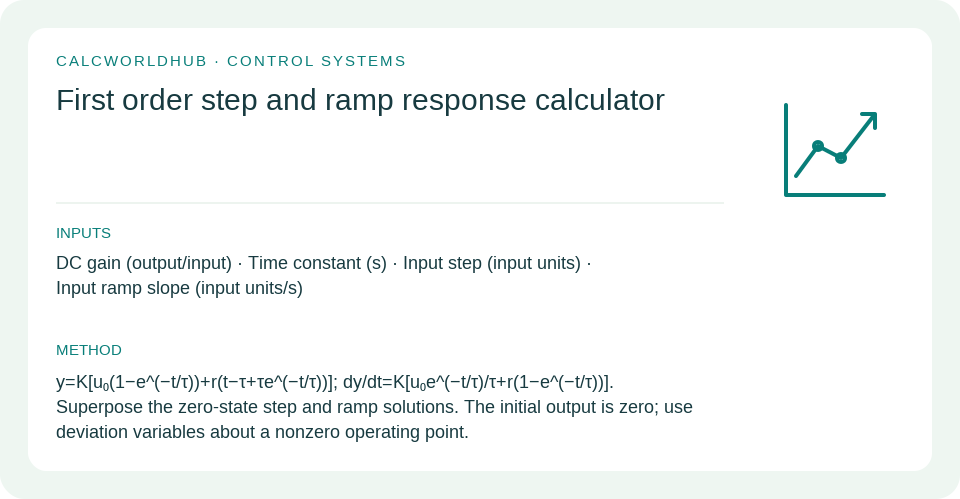
How to use this calculator
Predict a lagging sensor or process output when its command contains both a sudden change and a continuing ramp.
- Enter DC gain (output/input), Time constant (s), Input step (input units), Input ramp slope (input units/s), then complete the remaining labeled fields. Match the units shown beside each field and review the result together with the assumptions below.
- Read the worked example below to check the expected input format and result.
- Compare another scenario by changing one input at a time. Use Reset to return to the starting values.
First order step and ramp response explained
A unit step reaches 63.2% of its step-only final change after one time constant. A continuing ramp does not settle; this example evaluates the lagged step and ramp together at t = 4 s.
Inputs, symbols, and units
K— DC gain (output/input)- Steady output change per unit constant input.
tau— Time constant (s)- Positive lag time in tau dy/dt+y=K u.
u— Input step (input units)- Input jump applied at time zero.
r— Input ramp slope (input units/s)- Ramp added to the step after time zero.
t— Elapsed time (s)- Time after the step and ramp begin.
Formula and method
y=K[u₀(1−e^(−t/τ))+r(t−τ+τe^(−t/τ))]; dy/dt=K[u₀e^(−t/τ)/τ+r(1−e^(−t/τ))].
Superpose the zero-state step and ramp solutions. The initial output is zero; use deviation variables about a nonzero operating point.
A worked scenario
DC gain (output/input) = 2; Time constant (s) = 3; Input step (input units) = 1; Input ramp slope (input units/s) = 0.2; Elapsed time (s) = 4.
- Output: 2.189122 output units
- Output rate: 0.470293 output units/s
- Instantaneous input: 1.8 input units
A gain-two process with a three-second lag receives a unit jump and a 0.2-unit/s ramp; evaluate its output four seconds later.
Assumptions and edge cases
One stable real pole, no transport delay, no saturation, and zero initial deviation.
Reading the outputs
Output and its derivative retain your chosen process units; the final metric is the command at the evaluation time.
Frequently asked questions
Can I enter a falling ramp?
Yes. The ramp slope and step may be negative.
Does a ramp have a final output?
No. A continuing ramp does not settle to a constant output.
How is the time constant interpreted?
With a step alone, one time constant reaches about 63.2% of the final change.
How do I use the First order step and ramp response calculator?
Enter DC gain (output/input), Time constant (s), Input step (input units), Input ramp slope (input units/s), then complete the remaining labeled fields. Match the units shown beside each field and review the result together with the assumptions below.
What is a worked example of First order step and ramp response?
DC gain (output/input) = 2; Time constant (s) = 3; Input step (input units) = 1; Input ramp slope (input units/s) = 0.2; Elapsed time (s) = 4. Output: 2.189122 output units Output rate: 0.470293 output units/s Instantaneous input: 1.8 input units A gain-two process with a three-second lag receives a unit jump and a 0.2-unit/s ramp; evaluate its output four seconds later.
Read our calculation methodology.