How to use this calculator
Use a measured second virial coefficient to assess low-density gas pressure, nonideality and mechanical stability.
- Enter Absolute gas temperature (K), Molar volume (m³/mol), Second density-virial coefficient (m³/mol). Match the units shown beside each field and review the result together with the assumptions below.
- Read the worked example below to check the expected input format and result.
- Compare another scenario by changing one input at a time. Use Reset to return to the starting values.
Second virial density-form gas state and stability explained
Use Absolute gas temperature (K) with Molar volume (m³/mol) to reproduce the sample calculation, then review the stated limits before carrying the result into another scenario.
A numerical walkthrough
Absolute gas temperature (K) = 300; Molar volume (m³/mol) = 0.002; Second density-virial coefficient (m³/mol) = -0.0001.
- Absolute gas pressure: 1184810.923065 Pa
- Compressibility factor: 0.95
- Isothermal compressibility: 8.90906334e-07 1/Pa
At 300 K and molar volume 0.002 m³/mol, a second density-virial coefficient of −0.0001 m³/mol gives Z=0.95 and pressure 1.18481 MPa. The calculated positive compressibility checks that this truncated equation remains locally stable.
The model behind the numbers
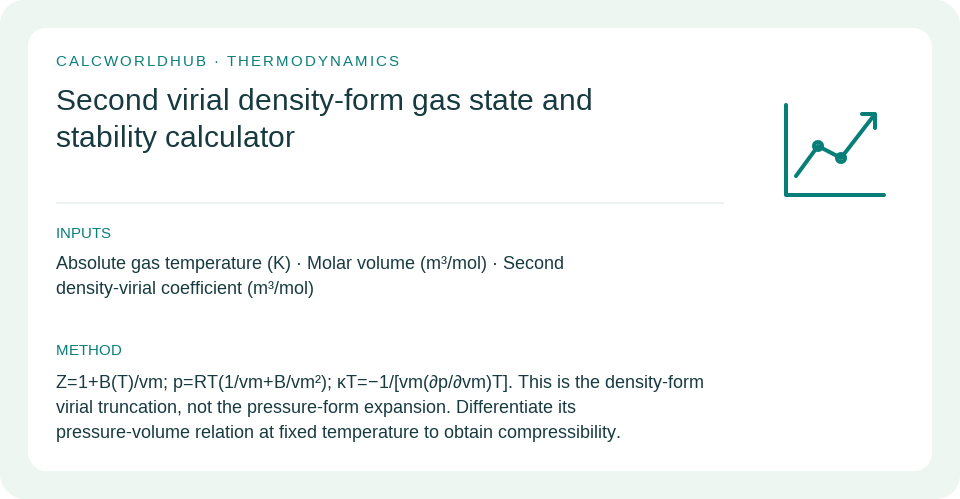
Z=1+B(T)/vm; p=RT(1/vm+B/vm²); κT=−1/[vm(∂p/∂vm)T].
This is the density-form virial truncation, not the pressure-form expansion. Differentiate its pressure-volume relation at fixed temperature to obtain compressibility.
What to enter
T— Absolute gas temperature (K)- Absolute gas temperature (K). Enter the value for this state; the units shown are used without an unstated conversion.
v— Molar volume (m³/mol)- Molar volume (m³/mol). Enter the value for this state; the units shown are used without an unstated conversion.
B— Second density-virial coefficient (m³/mol)- Second density-virial coefficient (m³/mol). Enter the value for this state; the units shown are used without an unstated conversion.
Interpreting the result
Use only at sufficiently low density where omitted higher virial terms are negligible. Rejects negative pressure and nonnegative pressure-volume slope, but passing those checks does not establish accuracy.
Reading the outputs
Pressure is Pa, Z dimensionless and isothermal compressibility Pa⁻¹.
Frequently asked questions
Is B the same coefficient in a pressure-series equation?
No. Density-form and pressure-form virial coefficients have different units and relations.
Can B be negative?
Yes. Attractions can make Z less than one within the dilute stable regime.
Does Z near one prove the truncation is valid?
No. Higher-order terms and property-data uncertainty still matter.
How do I use the Second virial density-form gas state and stability calculator?
Enter Absolute gas temperature (K), Molar volume (m³/mol), Second density-virial coefficient (m³/mol). Match the units shown beside each field and review the result together with the assumptions below.
What is a worked example of Second virial density-form gas state and stability?
Absolute gas temperature (K) = 300; Molar volume (m³/mol) = 0.002; Second density-virial coefficient (m³/mol) = -0.0001. Absolute gas pressure: 1184810.923065 Pa Compressibility factor: 0.95 Isothermal compressibility: 8.90906334e-07 1/Pa At 300 K and molar volume 0.002 m³/mol, a second density-virial coefficient of −0.0001 m³/mol gives Z=0.95 and pressure 1.18481 MPa. The calculated positive compressibility checks that this truncated equation remains locally stable.
Read our calculation methodology.