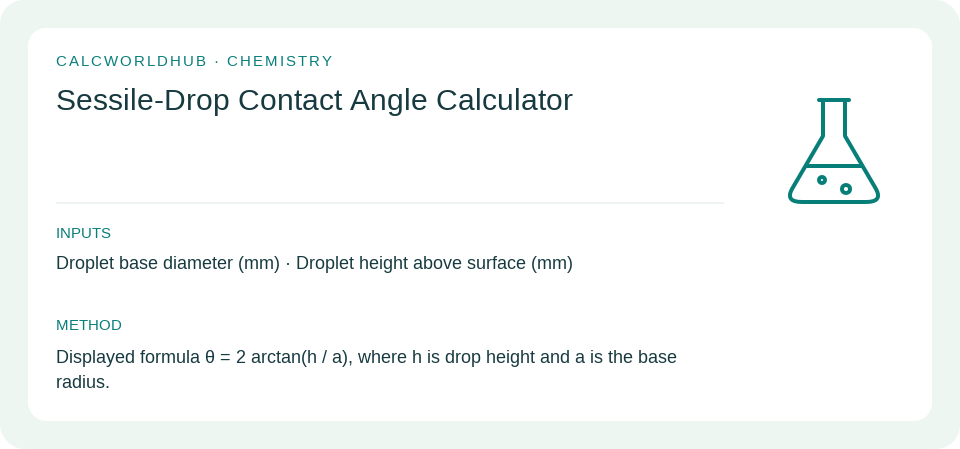
How to use this calculator
Estimate a sessile droplet’s contact angle from its measured base diameter and height using spherical-cap geometry.
- Enter Droplet base diameter (mm), Droplet height above surface (mm). Match the units shown beside each field and review the result together with the assumptions below.
- Read the worked example below to check the expected input format and result.
- Compare another scenario by changing one input at a time. Use Reset to return to the starting values.
How this calculation works
For an axisymmetric droplet that forms a spherical cap, the contact angle follows from the cap height and contact-line radius. This geometric estimate is useful for a quick image-based measurement, while full drop-shape analysis can account for gravity and non-spherical profiles.
Inputs and units
baseDiameterMm— Droplet base diameter (mm)- Diameter of the circular contact line where the droplet meets the surface.
dropHeightMm— Droplet height above surface (mm)- Maximum droplet height measured from the surface plane.
Formula
θ = 2 arctan(h / a), where h is drop height and a is the base radius.
Method
Measure the droplet height above the surface and the diameter of its circular base. The calculator halves the base diameter to obtain a, then reports the apparent contact angle through the liquid, spherical-cap volume, and equivalent-sphere radius.
Worked example
A 6.00 mm base diameter and 3.00 mm drop height give θ = 2 arctan(3/3) = 90.0°, with cap volume 56.55 mm³.
Assumptions and limits
The calculation assumes the droplet is an axisymmetric spherical cap on a flat surface. It is not a substitute for Young–Laplace drop-shape fitting when gravity, contact-line pinning, surface roughness, hysteresis, or an irregular drop shape matters.
Frequently asked questions
What is the contact angle convention here?
The angle is measured through the droplet at the three-phase contact line between the solid, liquid, and surrounding fluid.
Why assume a spherical cap?
It lets the angle be estimated directly from base radius and height when the droplet is approximately axisymmetric and gravity has not strongly distorted its shape.
Does this replace instrument-based drop analysis?
No. Use calibrated drop-shape analysis when surface characterization requires uncertainty estimates or a Young–Laplace fit.
How do I use the Sessile-Drop Contact Angle Calculator?
Enter Droplet base diameter (mm), Droplet height above surface (mm). Match the units shown beside each field and review the result together with the assumptions below.
What is a worked example of Sessile-Drop Contact Angle?
A 6.00 mm base diameter and 3.00 mm drop height give θ = 2 arctan(3/3) = 90.0°, with cap volume 56.55 mm³.
Reference: Peer-reviewed sessile-drop spherical-cap contact-angle geometry. See our calculation methodology.