How to use this calculator
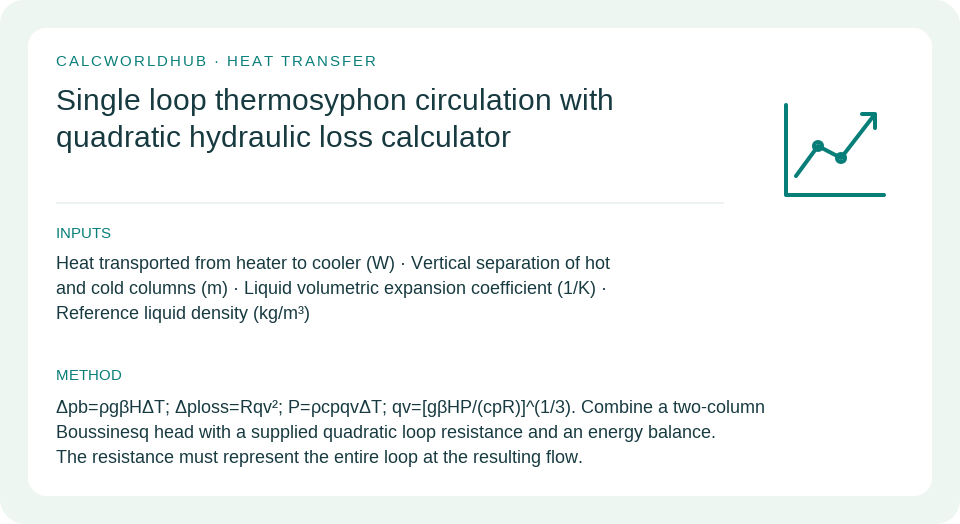
Estimate pump-free liquid circulation when a heated vertical leg and cooled return leg create a buoyancy pressure head.
- Enter Heat transported from heater to cooler (W), Vertical separation of hot and cold columns (m), Liquid volumetric expansion coefficient (1/K), Reference liquid density (kg/m³), then complete the remaining labeled fields. Match the units shown beside each field and review the result together with the assumptions below.
- Read the worked example below to check the expected input format and result.
- Compare another scenario by changing one input at a time. Use Reset to return to the starting values.
Single loop thermosyphon circulation with quadratic hydraulic loss explained
Use Heat transported from heater to cooler (W) with Vertical separation of hot and cold columns (m) to reproduce the sample calculation, then review the stated limits before carrying the result into another scenario.
Inputs, symbols, and units
P— Heat transported from heater to cooler (W)- Heat transported from heater to cooler (W). Enter the value for this state; the units shown are used without an unstated conversion.
H— Vertical separation of hot and cold columns (m)- Vertical separation of hot and cold columns (m). Enter the value for this state; the units shown are used without an unstated conversion.
beta— Liquid volumetric expansion coefficient (1/K)- Liquid volumetric expansion coefficient (1/K). Enter the value for this state; the units shown are used without an unstated conversion.
rho— Reference liquid density (kg/m³)- Reference liquid density (kg/m³). Enter the value for this state; the units shown are used without an unstated conversion.
cp— Liquid specific heat (J/kg/K)- Liquid specific heat (J/kg/K). Enter the value for this state; the units shown are used without an unstated conversion.
R— Quadratic loop pressure-loss coefficient (Pa s²/m⁶)- Quadratic loop pressure-loss coefficient (Pa s²/m⁶). Enter the value for this state; the units shown are used without an unstated conversion.
Formula and method
Δpb=ρgβHΔT; Δploss=Rqv²; P=ρcpqvΔT; qv=[gβHP/(cpR)]^(1/3).
Combine a two-column Boussinesq head with a supplied quadratic loop resistance and an energy balance. The resistance must represent the entire loop at the resulting flow.
A worked scenario
Heat transported from heater to cooler (W) = 500; Vertical separation of hot and cold columns (m) = 2; Liquid volumetric expansion coefficient (1/K) = 0.0003; Reference liquid density (kg/m³) = 998; Liquid specific heat (J/kg/K) = 4180; Quadratic loop pressure-loss coefficient (Pa s²/m⁶) = 100000000000.
- Natural circulation volumetric flow: 0.000019 m³/s
- Circulating mass flow: 0.019126 kg/s
- Hot to cold column temperature difference: 6.254241 K
- Buoyancy pressure head: 36.726293 Pa
Transporting 500 W through a loop with 2 m column separation, beta=0.0003/K and quadratic resistance 1e11 Pa s²/m⁶ produces 1.91641e−5 m³/s natural circulation. The columns differ by 6.25424 K, providing 36.7263 Pa buoyancy head.
Assumptions and edge cases
Single-phase loop, uniform hot and cold column temperatures, quadratic hydraulic resistance, negligible thermal leakage and small density variation. No startup, stability, boiling or detailed axial profiles.
Reading the outputs
Volume flow is m³/s, mass flow is kg/s, column temperature difference is K and head is Pa.
Frequently asked questions
Does this select a pipe diameter automatically?
No. Diameter, fittings and fluid properties determine the entered hydraulic resistance.
Why does flow scale only as power to one-third?
Higher power raises the temperature difference, but the resulting buoyancy must overcome a pressure loss proportional to flow squared.
Can the heater be above the cooler?
This model requires positive hot/cold column height separation supporting circulation; reversed layouts need a different head balance.
How do I use the Single loop thermosyphon circulation with quadratic hydraulic loss calculator?
Enter Heat transported from heater to cooler (W), Vertical separation of hot and cold columns (m), Liquid volumetric expansion coefficient (1/K), Reference liquid density (kg/m³), then complete the remaining labeled fields. Match the units shown beside each field and review the result together with the assumptions below.
What is a worked example of Single loop thermosyphon circulation with quadratic hydraulic loss?
Heat transported from heater to cooler (W) = 500; Vertical separation of hot and cold columns (m) = 2; Liquid volumetric expansion coefficient (1/K) = 0.0003; Reference liquid density (kg/m³) = 998; Liquid specific heat (J/kg/K) = 4180; Quadratic loop pressure-loss coefficient (Pa s²/m⁶) = 100000000000. Natural circulation volumetric flow: 0.000019 m³/s Circulating mass flow: 0.019126 kg/s Hot to cold column temperature difference: 6.254241 K Buoyancy pressure head: 36.726293 Pa Transporting 500 W through a loop with 2 m column separation, beta=0.0003/K and quadratic resistance 1e11 Pa s²/m⁶ produces 1.91641e−5 m³/s natural circulation.
Read our calculation methodology.