How to use this calculator
Budget amplifier and supply power for conventional full-carrier AM driven by one sinusoidal audio tone.
- Enter Unmodulated carrier power (W), Sinusoidal modulation index. Match the units shown beside each field and review the result together with the assumptions below.
- Read the worked example below to check the expected input format and result.
- Compare another scenario by changing one input at a time. Use Reset to return to the starting values.
Single-tone AM carrier and sideband power explained
The two sidebands share the added mean power equally; peak-envelope power is a separate peak quantity and should not be read as mean transmitted power.
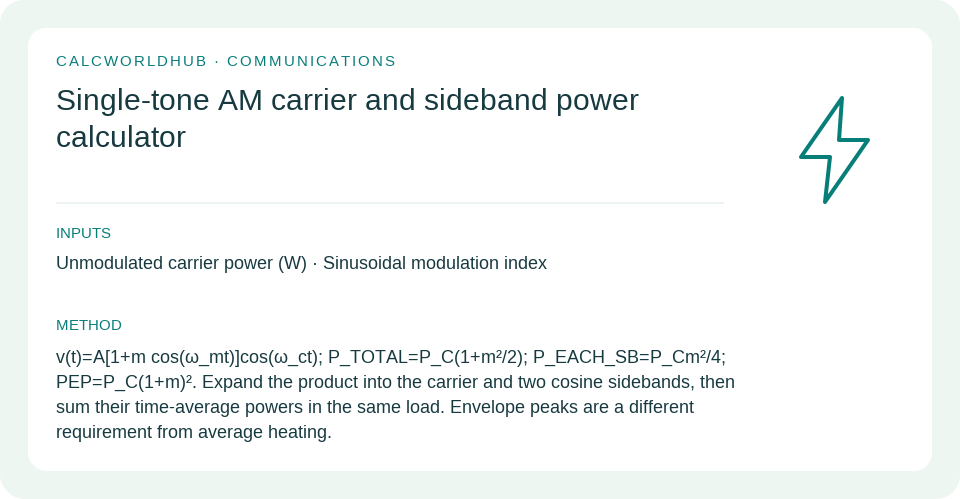
Inputs, symbols, and units
Pc— Unmodulated carrier power (W)- RF power with modulation removed, into a fixed matched load.
m— Sinusoidal modulation index- Envelope modulation depth; one is 100 percent.
Formula and method
v(t)=A[1+m cos(ω_mt)]cos(ω_ct); P_TOTAL=P_C(1+m²/2); P_EACH_SB=P_Cm²/4; PEP=P_C(1+m)².
Expand the product into the carrier and two cosine sidebands, then sum their time-average powers in the same load. Envelope peaks are a different requirement from average heating.
A worked scenario
Unmodulated carrier power (W) = 100; Sinusoidal modulation index = 0.8.
- Total mean AM power: 132 W
- Power in each first sideband: 16 W
- Peak-envelope power: 324 W
A 100 W carrier with modulation index 0.8 produces two 16 W sidebands, 132 W mean power and 324 W peak-envelope power.
Assumptions and edge cases
One sinusoidal modulating tone, ideal linear AM and m≤1. Speech statistics, suppressed-carrier modulation and overmodulation are outside this model.
Reading the outputs
Total mean and individual sideband powers describe spectral energy. PEP is the carrier-cycle average at the maximum envelope, not instantaneous RF peak power.
Frequently asked questions
Does 100 percent modulation double mean power?
No; it raises mean power to 1.5 times carrier power, while peak-envelope power becomes four times carrier power.
Why reject modulation index above one?
The envelope crosses zero and conventional envelope-detection assumptions break down.
Can I substitute RMS audio from speech?
Not directly; mean and peak speech modulation statistics must be treated separately.
How do I use the Single-tone AM carrier and sideband power calculator?
Enter Unmodulated carrier power (W), Sinusoidal modulation index. Match the units shown beside each field and review the result together with the assumptions below.
What is a worked example of Single-tone AM carrier and sideband power?
Unmodulated carrier power (W) = 100; Sinusoidal modulation index = 0.8. Total mean AM power: 132 W Power in each first sideband: 16 W Peak-envelope power: 324 W A 100 W carrier with modulation index 0.8 produces two 16 W sidebands, 132 W mean power and 324 W peak-envelope power.
Read our calculation methodology.