How to use this calculator
Compare the Carson bandwidth estimate with the actual discrete sideband power retained for a single-tone FM signal.
- Enter Peak frequency deviation (Hz), Modulating tone frequency (Hz), Sideband pairs retained. Match the units shown beside each field and review the result together with the assumptions below.
- Read the worked example below to check the expected input format and result.
- Compare another scenario by changing one input at a time. Use Reset to return to the starting values.
Single-tone FM modulation index and power retention explained
Estimate modulation index and Carson bandwidth for single-tone frequency modulation, with retained sideband power determined by the selected sideband count.
How the calculation works
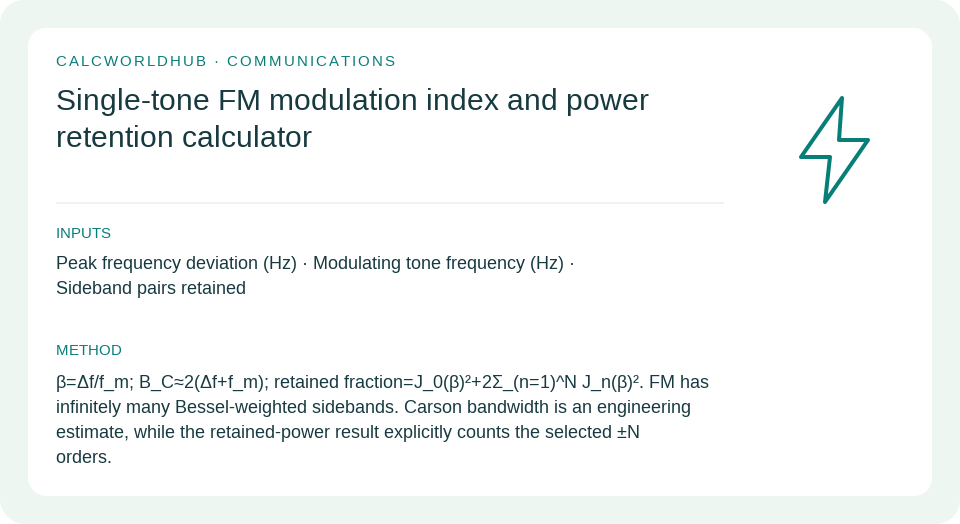
β=Δf/f_m; B_C≈2(Δf+f_m); retained fraction=J_0(β)²+2Σ_(n=1)^N J_n(β)².
FM has infinitely many Bessel-weighted sidebands. Carson bandwidth is an engineering estimate, while the retained-power result explicitly counts the selected ±N orders.
Set up the calculation
deviation— Peak frequency deviation (Hz)- Maximum instantaneous departure from carrier frequency.
fm— Modulating tone frequency (Hz)- Positive sinusoidal modulation frequency.
N— Sideband pairs retained- Keep carrier and orders ±1 through ±N in the retained-power calculation. Enter a whole number.
Limits of this model
Sinusoidal single-tone FM, no pre-emphasis, modulation spectrum or regulatory mask. Numerical Bessel integration is limited to beta≤100 and N≤60.
Check this example
Peak frequency deviation (Hz) = 75000; Modulating tone frequency (Hz) = 15000; Sideband pairs retained = 8.
- Carson estimated occupied bandwidth: 180000 Hz
- Modulation index: 5 dimensionless
- Power retained through specified sideband order: 0.999934 fraction
A 75 kHz peak deviation at a 15 kHz tone gives beta five; retaining eight sideband pairs can be assessed independently of the 180 kHz Carson estimate.
Reading the outputs
Bandwidth is a two-sided span in hertz. The retained fraction is carrier plus the selected symmetric pairs, not the fraction implied by an arbitrary channel filter.
Frequently asked questions
Is Carson bandwidth a hard spectral edge?
No; FM sidebands extend beyond it, and actual occupied-bandwidth definitions use a specified power percentage or mask.
Can peak deviation be replaced by RMS deviation?
No; beta here uses the peak sinusoidal frequency deviation.
What happens with zero deviation?
All power remains in the carrier; the Carson rule itself is only an estimate and still includes the supplied tone-frequency term.
How do I use the Single-tone FM modulation index and power retention calculator?
Enter Peak frequency deviation (Hz), Modulating tone frequency (Hz), Sideband pairs retained. Match the units shown beside each field and review the result together with the assumptions below.
What is a worked example of Single-tone FM modulation index and power retention?
Peak frequency deviation (Hz) = 75000; Modulating tone frequency (Hz) = 15000; Sideband pairs retained = 8. Carson estimated occupied bandwidth: 180000 Hz Modulation index: 5 dimensionless Power retained through specified sideband order: 0.999934 fraction A 75 kHz peak deviation at a 15 kHz tone gives beta five; retaining eight sideband pairs can be assessed independently of the 180 kHz Carson estimate.
Background or definition reference: NTIA necessary bandwidth and Carson rule.