How to use this calculator
Find the angle between direct sunlight and a fixed panel’s front-facing normal from solar and panel orientation.
- Enter Solar elevation above horizon (°), Solar azimuth clockwise from north (°), Panel tilt from horizontal (°), Panel azimuth clockwise from north (°). Match the units shown beside each field and review the result together with the assumptions below.
- Read the worked example below to check the expected input format and result.
- Compare another scenario by changing one input at a time. Use Reset to return to the starting values.
How this calculation works
The direct-beam component on a tilted surface is the direct-normal irradiance multiplied by the positive cosine of the incidence angle. Solar azimuth and panel azimuth must use the same north-referenced convention.
Inputs and units
solarElevationDeg— Solar elevation above horizon (°)- Sun elevation angle; 0° is the horizon and 90° is overhead.
solarAzimuthDeg— Solar azimuth clockwise from north (°)- Sun direction, with north 0°, east 90°, south 180°, and west 270°.
panelTiltDeg— Panel tilt from horizontal (°)- Panel plane tilt, with 0° horizontal and 90° vertical.
panelAzimuthDeg— Panel azimuth clockwise from north (°)- Direction the panel faces, using the same north-referenced convention as solar azimuth.
Formula
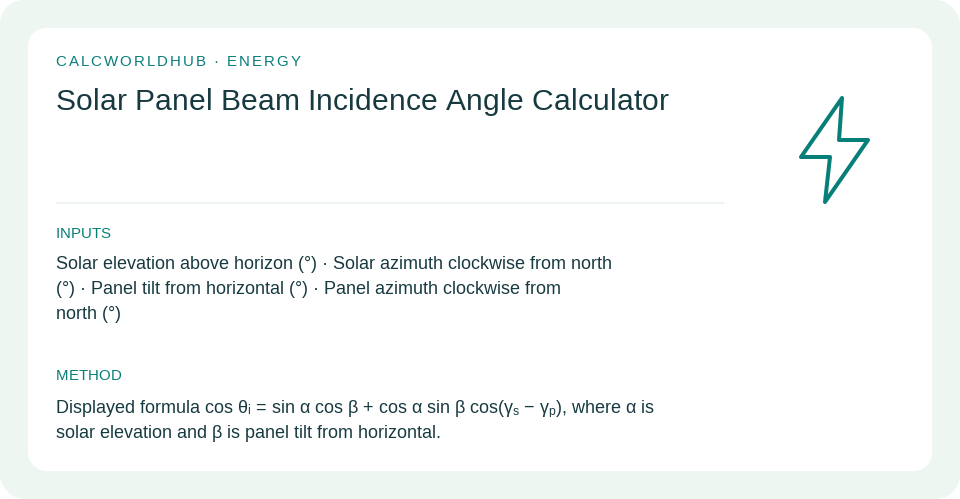
cos θᵢ = sin α cos β + cos α sin β cos(γₛ − γₚ), where α is solar elevation and β is panel tilt from horizontal.
Method
Enter solar elevation, solar azimuth clockwise from north, panel tilt from horizontal, and panel azimuth clockwise from north. The calculation resolves the sun direction against the panel normal, then reports the incidence angle and front-side direct-beam cosine factor.
Worked example
With the Sun 60° above the southern horizon and a south-facing panel tilted 30° from horizontal, the incidence angle is 0° and the direct-beam factor is 1.
Assumptions and limits
This gives orientation geometry for direct beam only. It does not estimate diffuse or ground-reflected irradiance, shading, atmospheric effects, module response, or energy production. Solar azimuth and panel azimuth must share the stated clockwise-from-north convention.
Frequently asked questions
What is the incidence angle?
It is the angle between the incoming solar beam and the panel’s front-facing normal.
What does the cosine factor mean?
For direct normal irradiance, multiply by this nonnegative factor to obtain the direct beam on the panel plane.
Does this calculate total panel irradiance?
No. Diffuse sky and ground-reflected radiation require separate irradiance models.
How do I use the Solar Panel Beam Incidence Angle Calculator?
Enter Solar elevation above horizon (°), Solar azimuth clockwise from north (°), Panel tilt from horizontal (°), Panel azimuth clockwise from north (°). Match the units shown beside each field and review the result together with the assumptions below.
What is a worked example of Solar Panel Beam Incidence Angle?
With the Sun 60° above the southern horizon and a south-facing panel tilted 30° from horizontal, the incidence angle is 0° and the direct-beam factor is 1.
Reference: NREL SOLPOS solar position and tilted-panel incidence-angle documentation. See our calculation methodology.