How to use this calculator
Estimate Saint-Venant torsional stiffness and elastic twist of a solid rectangular bar without treating its polar area moment as its torsion constant.
- Enter First section side (mm), Second section side (mm), Applied torque (N m), Bar length (mm), then complete the remaining labeled fields. Match the units shown beside each field and review the result together with the assumptions below.
- Read the worked example below to check the expected input format and result.
- Compare another scenario by changing one input at a time. Use Reset to return to the starting values.
Solid rectangular bar torsional stiffness explained
Estimate Saint-Venant torsional stiffness and signed elastic twist for a solid rectangular bar.
How the calculation works
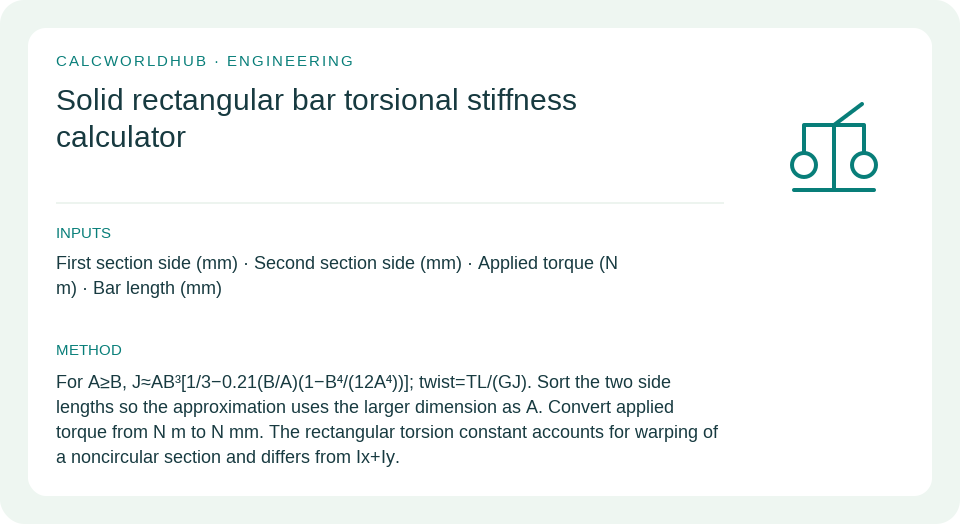
For A≥B, J≈AB³[1/3−0.21(B/A)(1−B⁴/(12A⁴))]; twist=TL/(GJ).
Sort the two side lengths so the approximation uses the larger dimension as A. Convert applied torque from N m to N mm. The rectangular torsion constant accounts for warping of a noncircular section and differs from Ix+Iy.
Set up the calculation
a— First section side (mm)- One side of the solid rectangular cross-section; the section constant uses the longer and shorter sides in that order.
b— Second section side (mm)- The other cross-section side. The smaller side has a strong cubic effect on the approximate torsion constant.
T— Applied torque (N m)- Signed torque about the bar axis; its sign determines the reported twist direction.
L— Bar length (mm)- Uniform span between torque application and restraint, measured along the bar axis.
G— Shear modulus (MPa)- Elastic shear modulus; 1 MPa equals 1 N/mm² in the unit conversion used for twist.
Limits of this model
Uniform solid rectangle, isotropic linear elasticity, free Saint-Venant warping away from restraints. J is an engineering approximation; restrained warping, open thin-wall sections, plastic torsion, and stress concentration are excluded.
Check this example
First section side (mm) = 40; Second section side (mm) = 12; Applied torque (N m) = 80; Bar length (mm) = 600; Shear modulus (MPa) = 80000.
- Approximate rectangular torsion constant: 18688.379328 mm^4
- Elastic angle of twist: 0.032105513 radians
- Elastic twist in degrees: 1.83951038 degrees
- Torsional stiffness: 2491.78391 N m/radian
A forty-by-twelve-millimetre bar is relatively thin in one direction. The cubic dependence on the smaller side makes that thickness important for twist.
The approximate torsion constant is 18,688.38 mm⁴ and the signed twist is 0.032106 rad for this torque and span.
Reading the outputs
Twist retains the torque sign. The stiffness output is N m per radian; it is not a section bending modulus.
Frequently asked questions
Can I use a hollow rectangular tube?
No. Hollow sections need a different torsion model.
Why not use Ix+Iy?
For noncircular sections the torsion constant differs from the polar second moment of area.
Can the two side inputs be swapped?
Yes. The method sorts them internally.
How do I use the Solid rectangular bar torsional stiffness calculator?
Enter First section side (mm), Second section side (mm), Applied torque (N m), Bar length (mm), then complete the remaining labeled fields. Match the units shown beside each field and review the result together with the assumptions below.
What is a worked example of Solid rectangular bar torsional stiffness?
First section side (mm) = 40; Second section side (mm) = 12; Applied torque (N m) = 80; Bar length (mm) = 600; Shear modulus (MPa) = 80000. Approximate rectangular torsion constant: 18688.379328 mm^4 Elastic angle of twist: 0.032105513 radians Elastic twist in degrees: 1.83951038 degrees Torsional stiffness: 2491.78391 N m/radian A forty-by-twelve-millimetre bar is relatively thin in one direction. The cubic dependence on the smaller side makes that thickness important for twist. The approximate torsion constant is 18,688.38 mm⁴ and the signed twist is 0.032106 rad for this torque and span.
Background or definition reference: MIT mechanics of materials background.
Read our calculation methodology.