How to use this calculator
Convert pre-fermentation wort specific gravity to an approximate degrees Plato extract value.
- Enter Specific gravity (SG). Match the units shown beside each field and review the result together with the assumptions below.
- Read the worked example below to check the expected input format and result.
- Compare another scenario by changing one input at a time. Use Reset to return to the starting values.
How this calculation works
Brewers may record wort density as specific gravity or as degrees Plato, which expresses extract as an approximate mass percentage. This page converts a temperature-corrected hydrometer reading with a polynomial fit to tabulated gravity values; it is a wort-strength conversion, not a fermentation-alcohol correction.
Inputs and units
specificGravity— Specific gravity (SG)- Enter a temperature-corrected ratio such as 1.050; supported range is 1.000 to 1.200.
Formula
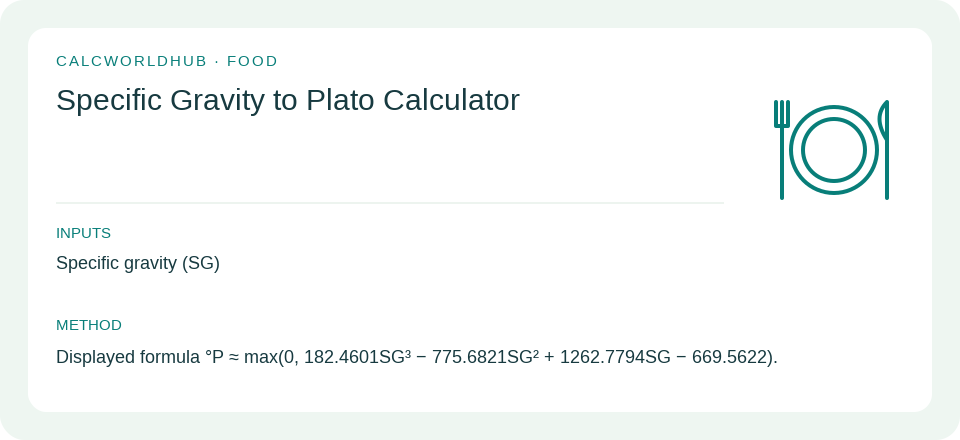
°P ≈ max(0, 182.4601SG³ − 775.6821SG² + 1262.7794SG − 669.5622).
Method
Enter specific gravity as a ratio such as 1.050, within 1.000–1.200. The calculator evaluates the stated cubic fit and clamps a tiny negative result at the water reference to 0 °P. Treat it as an approximation to tabulated values, not a direct measurement of dissolved extract.
Worked example
For SG 1.050, the cubic fit gives approximately 12.39 °P. Small differences from a lookup table can occur because the polynomial is an approximation.
Assumptions and limits
The polynomial is a fit to brewing gravity tables, not an exact physical identity. Use a hydrometer or refractometer reading corrected for its calibration temperature. Alcohol changes refractometer behavior after fermentation, so this simple conversion is intended for wort or another unfermented solution.
Frequently asked questions
Are degrees Plato exactly the same as specific gravity?
No. They are different ways to describe wort density or extract. This calculator estimates one from the other using a fitted polynomial.
Should I temperature-correct a hydrometer reading first?
Yes. Enter a gravity value corrected to the instrument’s calibration temperature, following the procedure supplied with the instrument.
Can I use this for finished beer measured with a refractometer?
Not by itself. Alcohol affects readings after fermentation; use an alcohol-corrected method designed for fermented samples.
How do I use the Specific Gravity to Plato Calculator?
Enter Specific gravity (SG). Match the units shown beside each field and review the result together with the assumptions below.
What is a worked example of Specific Gravity to Plato?
For SG 1.050, the cubic fit gives approximately 12.39 °P. Small differences from a lookup table can occur because the polynomial is an approximation.
Reference: Brewer’s Friend explanation of the specific-gravity to Plato polynomial fit. See our calculation methodology.