How to use this calculator
Interpolate at constant angular progress along the shorter unit-sphere arc between two 3D directions.
- Enter Start direction (x,y,z), End direction (x,y,z), Interpolation fraction. Match the units shown beside each field and review the result together with the assumptions below.
- Read the worked example below to check the expected input format and result.
- Compare another scenario by changing one input at a time. Use Reset to return to the starting values.
Spherical linear vector interpolation explained
SLERP normalizes two nonzero input vectors and moves along the shorter great-circle arc between their directions. The fraction t sets angular progress: t=0 returns the start direction and t=1 returns the end direction.
How the calculation works
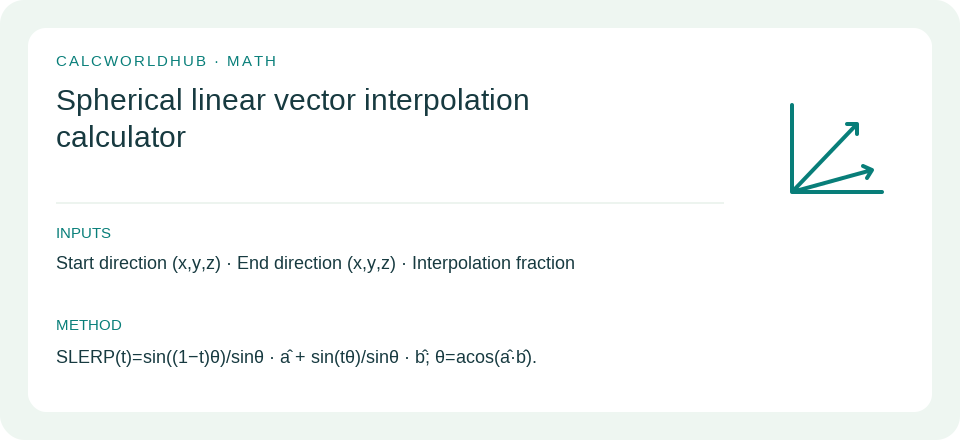
SLERP(t)=sin((1−t)θ)/sinθ · â + sin(tθ)/sinθ · b̂; θ=acos(â·b̂).
Inputs and units
- Start direction (x,y,z)
- Nonzero direction normalized internally.
- End direction (x,y,z)
- Second nonzero direction.
- Interpolation fraction
- Position from start 0 to end 1.
Limits of this model
This interpolates direction vectors, not quaternion orientations. Antipodal directions require an additional axis choice and are rejected.
Ordinary vector interpolation follows a straight chord. SLERP follows a spherical arc and keeps unit magnitude.
Check a numerical scenario
Start direction (x,y,z) = 1,0,0; End direction (x,y,z) = 0,1,0; Interpolation fraction = 0.5.
- Interpolated unit direction: 0.70710678, 0.70710678, 0 x, y, z
- Angular travel from start: 45 degrees
For unit directions (1,0,0) and (0,1,0), the angle is 90°. At t=0.5, SLERP returns (√½,√½,0) and has traveled 45° from the start.
Frequently asked questions
Are input magnitudes preserved?
No. Both inputs are normalized to directions.
Why reject opposite directions?
Infinitely many equally short half-circle arcs connect antipodes.
Does t=0.5 mean half the angular distance?
Yes under the spherical interpolation model.
How do I use the Spherical linear vector interpolation calculator?
Enter Start direction (x,y,z), End direction (x,y,z), Interpolation fraction. Match the units shown beside each field and review the result together with the assumptions below.
What is a worked example of Spherical linear vector interpolation?
Start direction (x,y,z) = 1,0,0; End direction (x,y,z) = 0,1,0; Interpolation fraction = 0.5. Interpolated unit direction: 0.70710678, 0.70710678, 0 x, y, z Angular travel from start: 45 degrees For unit directions (1,0,0) and (0,1,0), the angle is 90°. At t=0.5, SLERP returns (√½,√½,0) and has traveled 45° from the start.
See our calculation methodology.