How to use this calculator
Calculate Christiansen’s uniformity coefficient from measured catch-can depths collected during an irrigation test.
- Enter Catch-can depths (mm or inches). Match the units shown beside each field and review the result together with the assumptions below.
- Read the worked example below to check the expected input format and result.
- Compare another scenario by changing one input at a time. Use Reset to return to the starting values.
How this calculation works
A catch-can test samples how much water reaches multiple points during one sprinkler application. Christiansen’s coefficient summarizes the average absolute deviation of those catches from their mean; it is a descriptive uniformity measure, not an application-efficiency estimate.
Inputs and units
catches— Catch-can depths (mm or inches)- Measured water depth for each collector from the same irrigation test.
Formula
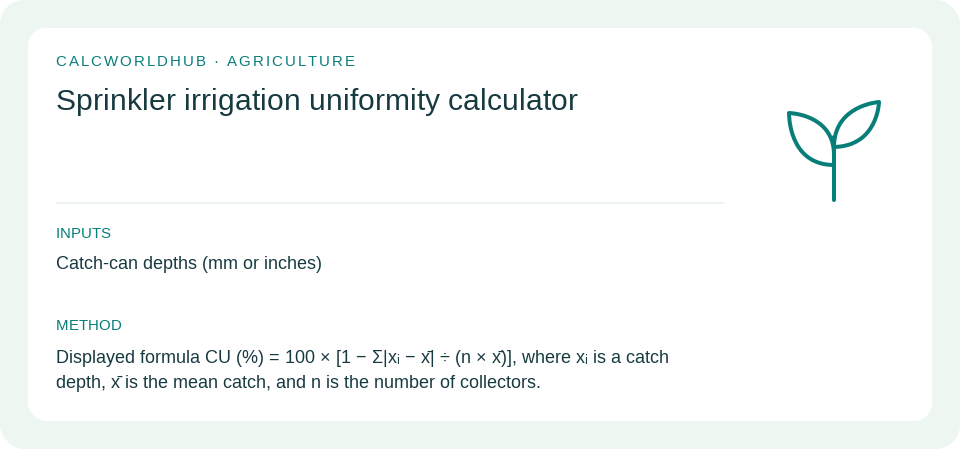
CU (%) = 100 × [1 − Σ|xᵢ − x̄| ÷ (n × x̄)], where xᵢ is a catch depth, x̄ is the mean catch, and n is the number of collectors.
Method
Enter at least two nonnegative catch depths in matching units, separated by commas or spaces. Collectors should represent the test layout and exposure period; do not mix measurements from different runs or container areas.
Worked example
Catch depths of 18, 20, 22, and 24 mm have a mean of 21 mm and total absolute deviation of 8 mm. CU = 100 × [1 − 8 ÷ (4 × 21)] = 90.48%.
Assumptions and limits
The coefficient does not identify the cause of uneven application or replace a crop-specific irrigation assessment. Wind, catch-can placement, pressure variation, nozzle condition, and test duration affect results. Use a method suited to the irrigation system; center pivots may require weighted formulas.
Frequently asked questions
Do the catch containers need equal openings?
Use consistent collectors and the measurement procedure recommended for the irrigation system so collected depth is comparable.
Does CU show how much water the crop received?
It summarizes spatial uniformity. Mean catch depth describes the amount collected, while crop requirement and application efficiency need additional information.
Can I use this formula for every irrigation system?
No. Some systems, including center pivots, use weighted versions that account for the sampling geometry.
How do I use the Sprinkler irrigation uniformity calculator?
Enter Catch-can depths (mm or inches). Match the units shown beside each field and review the result together with the assumptions below.
What is a worked example of Sprinkler irrigation uniformity?
Catch depths of 18, 20, 22, and 24 mm have a mean of 21 mm and total absolute deviation of 8 mm. CU = 100 × [1 − 8 ÷ (4 × 21)] = 90.48%.
Reference: University of Georgia Cooperative Extension sprinkler uniformity guidance. See our calculation methodology.