How to use this calculator
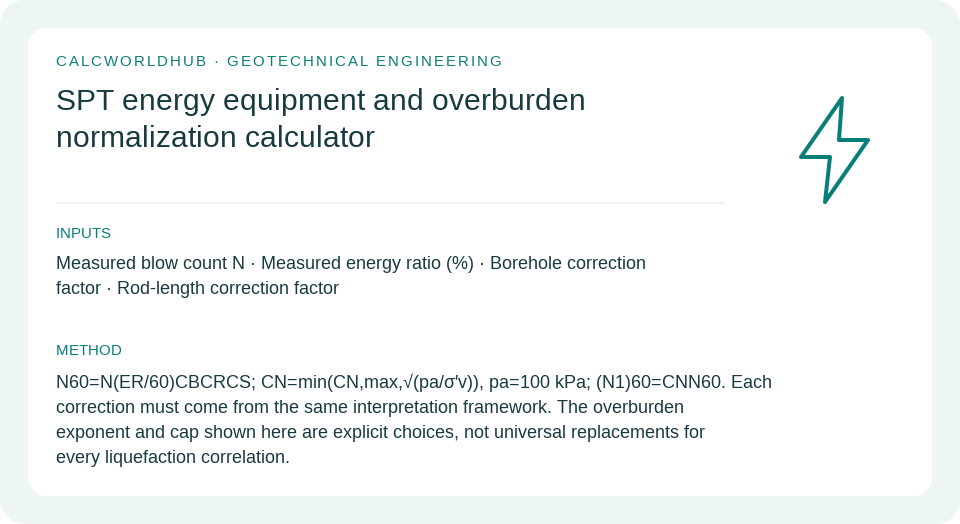
Normalize a measured SPT result for energy, equipment and a stated square-root overburden convention without inventing soil strength from the blow count.
- Enter Measured blow count N, Measured energy ratio (%), Borehole correction factor, Rod-length correction factor, then complete the remaining labeled fields. Match the units shown beside each field and review the result together with the assumptions below.
- Read the worked example below to check the expected input format and result.
- Compare another scenario by changing one input at a time. Use Reset to return to the starting values.
SPT energy equipment and overburden normalization explained
A numerical walkthrough
Measured blow count N = 18; Measured energy ratio (%) = 75; Borehole correction factor = 1; Rod-length correction factor = 0.85; Sampler correction factor = 1; Effective overburden (kPa) = 80; Maximum overburden factor = 1.7.
- Normalized (N1)60: 21.3824 blows
- Energy-corrected N60: 19.125 blows
- Overburden factor CN: 1.118034
For N=18, ER=75%, CR=0.85 and other equipment factors 1, N60=19.125 blows. At 80 kPa effective stress CN≈1.118.
The model behind the numbers
N60=N(ER/60)CBCRCS; CN=min(CN,max,√(pa/σ′v)), pa=100 kPa; (N1)60=CNN60.
Each correction must come from the same interpretation framework. The overburden exponent and cap shown here are explicit choices, not universal replacements for every liquefaction correlation.
What to enter
N— Measured blow count N- Field blows for the designated SPT penetration interval, excluding the seating drive.
ER— Measured energy ratio (%)- Hammer energy delivered to rods as a percentage of theoretical potential energy.
CB— Borehole correction factor- Specified borehole-diameter factor for the chosen SPT interpretation.
CR— Rod-length correction factor- Specified correction for rod length.
CS— Sampler correction factor- Specified sampler configuration factor.
sv— Effective overburden (kPa)- Effective vertical stress at the test depth.
CNmax— Maximum overburden factor- Explicit cap for CN; its suitability depends on the correlation being used.
Interpreting the result
Does not correct for fines, gravel, refusal, sampler disturbance or derive a bearing capacity. Some correlations require a different stress normalization. Educational model; this is not a code-compliant design check.
Reading the outputs
Corrected blow counts remain blows for the stated penetration interval; CN is dimensionless.
Frequently asked questions
Can I assume 60% energy because I need N60?
No. Enter measured or appropriately established delivered energy, then normalize to the 60% reference.
Is (N1)60 already fines-corrected?
No. This result has no clean-sand or fines-content correction.
Why is a CN cap exposed?
Low overburden otherwise produces arbitrarily large normalization; the applicable method should establish the cap.
How do I use the SPT energy equipment and overburden normalization calculator?
Enter Measured blow count N, Measured energy ratio (%), Borehole correction factor, Rod-length correction factor, then complete the remaining labeled fields. Match the units shown beside each field and review the result together with the assumptions below.
What is a worked example of SPT energy equipment and overburden normalization?
Measured blow count N = 18; Measured energy ratio (%) = 75; Borehole correction factor = 1; Rod-length correction factor = 0.85; Sampler correction factor = 1; Effective overburden (kPa) = 80; Maximum overburden factor = 1.7. Normalized (N1)60: 21.3824 blows Energy-corrected N60: 19.125 blows Overburden factor CN: 1.118034 For N=18, ER=75%, CR=0.85 and other equipment factors 1, N60=19.125 blows. At 80 kPa effective stress CN≈1.118.
Background or definition reference: FHWA Soils and Foundations Reference Manual, Volume I.
Read our calculation methodology.