Standard error of difference calculator
Estimate the standard error of an independent difference of means from two sample standard deviations and sample sizes.
inputs.
How to use this calculator
For two independent samples, the standard error of the difference between means combines the uncertainty from each group. This calculator uses the unpooled Welch form, which does not assume equal population variances. It relies on independent observations and the sample standard deviations you provide; it does not compute a degrees-of-freedom adjustment or a confidence interval by itself.
Formula
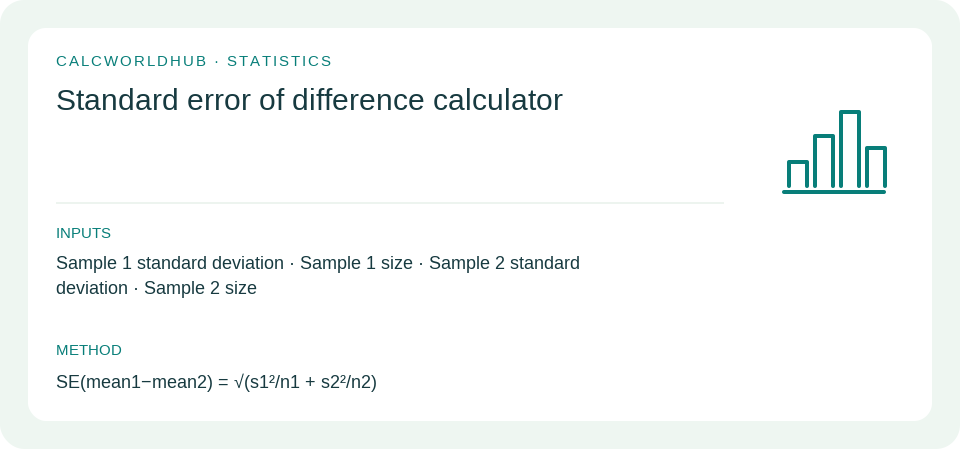
SE(diff) = √(s₁²/n₁ + s₂²/n₂)
Assumptions and limits
Inputs should use consistent units and valid values. The result is a planning aid; review the assumptions above and verify the method fits your situation before relying on it.
How to use this calculator
Estimate the standard error of an independent difference of means from two sample standard deviations and sample sizes.
- Enter Sample 1 standard deviation, Sample 1 size, Sample 2 standard deviation, Sample 2 size. Match the units shown beside each field and review the result together with the assumptions below.
- Read the worked example below to check the expected input format and result.
- Compare another scenario by changing one input at a time. Use Reset to return to the starting values.
How the Standard error of difference calculator works
Estimate the standard error of an independent difference of means from two sample standard deviations and sample sizes.
Inputs and units
- Sample 1 standard deviation: Nonnegative first sample standard deviation in the measurement unit.
- Sample 1 size: Whole first sample count, at least 2.
- Sample 2 standard deviation: Nonnegative second sample standard deviation, in the same unit.
- Sample 2 size: Whole second sample count, at least 2; affects the second variance contribution.
Formula and method
SE(mean1−mean2) = √(s1²/n1 + s2²/n2)
Worked example
For s1=8, n1=25, s2=10, n2=30: variance contributions are 64/25=2.56 and 100/30=3.333333. SE = √5.893333 = 2.427619 units.
Interpreting the result
This is the estimated sampling uncertainty of the difference of means, in the original measurement unit. It is not a required sample count or a confidence interval by itself.
Assumptions and limits
Assumes independent samples. Paired observations require the variability of within-pair differences. Sample sizes must be whole numbers of at least two; standard deviations can be zero.
Sources and method
- Gives independent-sample variance contributions and distinguishes pooled and unequal-variance comparisons. NIST: two-sample t-test for equal means
Frequently asked questions
Does this assume equal population variances?
No. The two variance contributions are estimated separately; this is the standard error used in an unequal-variance comparison.
What if both sample standard deviations are zero?
The plug-in SE is zero. That does not establish that sampling and measurement uncertainty are absent in the underlying process.
How do I use the Standard error of difference calculator?
Enter Sample 1 standard deviation, Sample 1 size, Sample 2 standard deviation, Sample 2 size. Match the units shown beside each field and review the result together with the assumptions below.
What is a worked example of Standard error of difference?
For s1=8, n1=25, s2=10, n2=30: variance contributions are 64/25=2.56 and 100/30=3.333333. SE = √5.893333 = 2.427619 units.
What does the Standard error of difference calculator calculate?
Estimate the standard error of an independent difference of means from two sample standard deviations and sample sizes.
See the calculation methodology.