Pooled variance calculator
Pool two sample variances with degrees-of-freedom weights when estimating a common within-group variance.
inputs.
How to use this calculator
Pool two sample variances with degrees-of-freedom weights when estimating a common within-group variance.
- Enter Sample 1 SD, Sample 1 size, Sample 2 SD, Sample 2 size. Match the units shown beside each field and review the result together with the assumptions below.
- Read the worked example below to check the expected input format and result.
- Compare another scenario by changing one input at a time. Use Reset to return to the starting values.
How the Pooled variance calculator works
Pool two sample variances with degrees-of-freedom weights when estimating a common within-group variance.
Inputs and units
- Sample 1 SD: First sample standard deviation, nonnegative.
- Sample 1 size: First sample size, a whole number of at least 2.
- Sample 2 SD: Second sample standard deviation, nonnegative and in the same units.
- Sample 2 size: Second sample size, a whole number of at least 2.
Formula and method
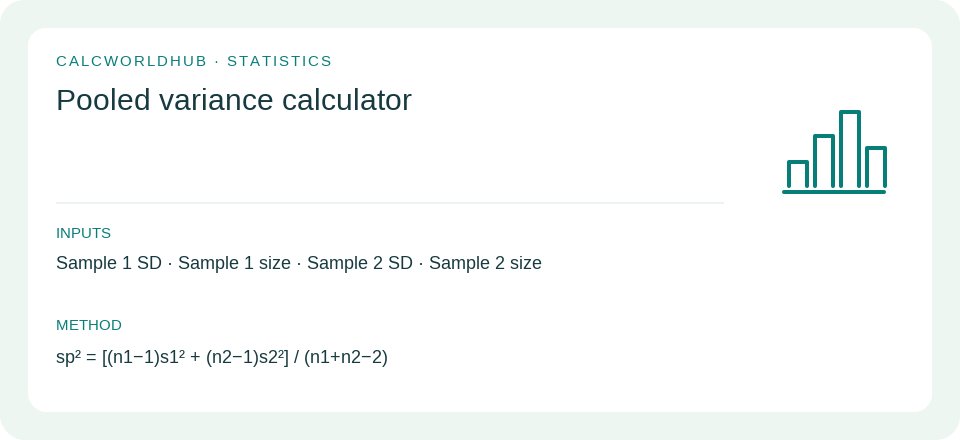
sp² = [(n1−1)s1² + (n2−1)s2²] / (n1+n2−2)
Worked example
With s1 = 4, n1 = 16, s2 = 5, n2 = 21: (15×16 + 20×25)/35 = 21.142857 variance units.
Interpreting the result
The result is a variance, so its unit is the square of the original measurement unit. Its square root is the pooled standard deviation.
Assumptions and limits
Assumes two independent samples and a shared population variance when used for inference. This is not the overall variance of concatenated groups with different means.
Sources and method
- Gives independent-sample variance contributions and distinguishes pooled and unequal-variance comparisons. NIST: two-sample t-test for equal means
Frequently asked questions
Why are variances weighted by n−1?
Each sample variance contributes its residual sum of squares, (n−1)s². The combined denominator adds those degrees of freedom.
Is this the variance of all observations combined?
Not in general. Overall variance also reflects differences between group means, which are not inputs here.
How do I use the Pooled variance calculator?
Enter Sample 1 SD, Sample 1 size, Sample 2 SD, Sample 2 size. Match the units shown beside each field and review the result together with the assumptions below.
What is a worked example of Pooled variance?
With s1 = 4, n1 = 16, s2 = 5, n2 = 21: (15×16 + 20×25)/35 = 21.142857 variance units.
What does the Pooled variance calculator calculate?
Pool two sample variances with degrees-of-freedom weights when estimating a common within-group variance.
See the calculation methodology.