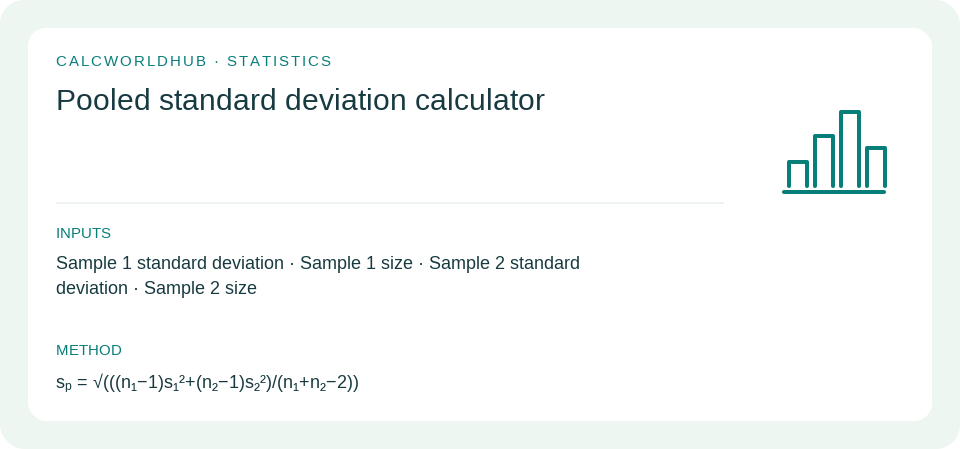
How to use this calculator
Combine two sample standard deviations into a shared within-group estimate under an equal-variance model.
- Enter Sample 1 standard deviation, Sample 1 size, Sample 2 standard deviation, Sample 2 size. Match the units shown beside each field and review the result together with the assumptions below.
- Read the worked example below to check the expected input format and result.
- Compare another scenario by changing one input at a time. Use Reset to return to the starting values.
How Pooled standard deviation calculator works
Combine two sample standard deviations into a shared within-group estimate under an equal-variance model.
Inputs and units
- Sample 1 standard deviation: Sample 1 standard deviation s₁ in the measured units.
- Sample 1 size: Sample 1 size n₁; it supplies n₁−1 degrees of freedom.
- Sample 2 standard deviation: Sample 2 standard deviation s₂ in the same units as s₁.
- Sample 2 size: Sample 2 size n₂; it supplies n₂−1 degrees of freedom.
Formula and method
sₚ = √(((n₁−1)s₁²+(n₂−1)s₂²)/(n₁+n₂−2))
Worked example
With s₁=4.2, n₁=18, s₂=5.1, and n₂=22, sₚ=√((17·4.2²+21·5.1²)/38)≈4.7186.
Interpreting the result
The pooled SD is a degrees-of-freedom-weighted within-group spread, expressed in the original measurement units.
Assumptions and limits
Each sample size must be a whole number of at least two and SDs must be nonnegative. Pooling is appropriate only when a common population variance is a defensible assumption.
Sources and method
- Equal-variance two-sample t statistic, pooled standard deviation, degrees of freedom, and two-tailed test. NIST/SEMATECH Dataplot, T TEST
Frequently asked questions
Why are sample sizes used as weights?
Each sample contributes its degrees of freedom, n−1, to the pooled variance.
Does pooling prove the variances are equal?
No. It assumes a common variance; the data and study design must support that choice.
How do I use the Pooled standard deviation calculator?
Enter Sample 1 standard deviation, Sample 1 size, Sample 2 standard deviation, Sample 2 size. Match the units shown beside each field and review the result together with the assumptions below.
What is a worked example of Pooled standard deviation?
With s₁=4.2, n₁=18, s₂=5.1, and n₂=22, sₚ=√((17·4.2²+21·5.1²)/38)≈4.7186.
What does the Pooled standard deviation calculator calculate?
Combine two sample standard deviations into a shared within-group estimate under an equal-variance model.