How to use this calculator
Free Standard error of difference in means calculator. Estimate sampling variability for the difference between two independent sample means.
- Enter Group 1 SD / Group 2 SD, Group 1 sample size / Group 2 sample size. Match the units shown beside each field and review the result together with the assumptions below.
- Read the worked example below to check the expected input format and result.
- Compare another scenario by changing one input at a time. Use Reset to return to the starting values.
Sampling uncertainty for two independent sample means
This standard error estimates how much a difference between two independent sample means would vary across repeated samples under the same conditions. It is calculated from each group’s spread and size, not from the two observed means.
Inputs for this calculation
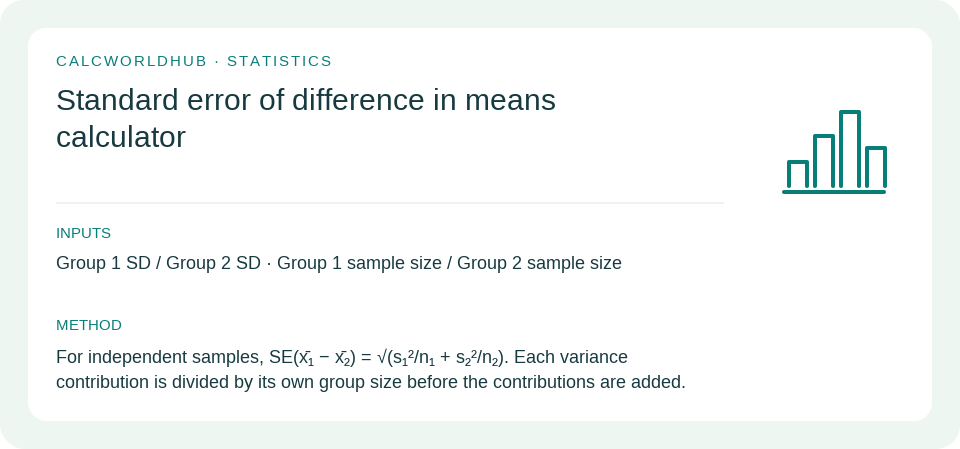
- Group 1 SD / Group 2 SD: Sample standard deviations for the outcome, measured in the same units.
- Group 1 sample size / Group 2 sample size: Independent observation counts for each group; larger samples reduce the corresponding variance contribution.
Formula and method
For independent samples, SE(x̄₁ − x̄₂) = √(s₁²/n₁ + s₂²/n₂). Each variance contribution is divided by its own group size before the contributions are added.
Worked example
With s₁ = 4 and n₁ = 25, the first contribution is 16/25 = 0.64. With s₂ = 3 and n₂ = 36, the second is 9/36 = 0.25. The standard error is √(0.64 + 0.25) = √0.89 ≈ 0.9434 outcome units.
Reading the result
The 0.9434 value describes estimated sampling variability for a difference in means. A confidence interval or test also needs the observed mean difference and an appropriate reference distribution.
Assumptions and limits
This formula assumes independent samples. For paired or repeated measurements, calculate the standard deviation of within-pair differences and use the paired-sample method instead.
Related calculators
Frequently asked questions
How do I use the Standard error of difference in means calculator?
Enter Group 1 SD / Group 2 SD, Group 1 sample size / Group 2 sample size. Match the units shown beside each field and review the result together with the assumptions below.
What is a worked example of Standard error of difference in means?
With s₁ = 4 and n₁ = 25, the first contribution is 16/25 = 0.64. With s₂ = 3 and n₂ = 36, the second is 9/36 = 0.25. The standard error is √(0.64 + 0.25) = √0.89 ≈ 0.9434 outcome units.
What does the Standard error of difference in means calculator calculate?
Free Standard error of difference in means calculator. Estimate sampling variability for the difference between two independent sample means.
What assumptions apply to Standard error of difference in means?
This formula assumes independent samples. For paired or repeated measurements, calculate the standard deviation of within-pair differences and use the paired-sample method instead.
Which method does the Standard error of difference in means calculator use?
For independent samples, SE(x̄₁ − x̄₂) = √(s₁²/n₁ + s₂²/n₂). Each variance contribution is divided by its own group size before the contributions are added.