Difference of means confidence interval calculator
Estimate a two-sided Welch confidence interval for the difference of two independent population means from sample summaries.
How to use this calculator
Estimate a two-sided Welch confidence interval for the difference of two independent population means from sample summaries.
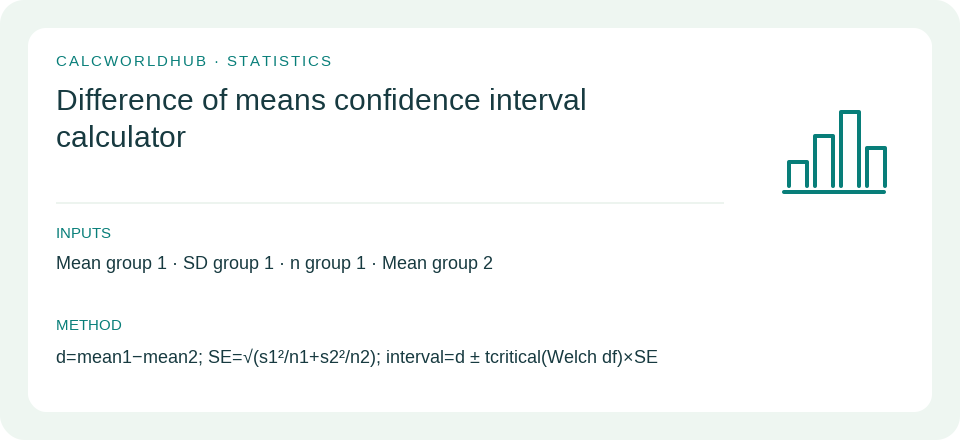
- Enter Mean group 1, SD group 1, n group 1, Mean group 2, then complete the remaining labeled fields. Match the units shown beside each field and review the result together with the assumptions below.
- Read the worked example below to check the expected input format and result.
- Compare another scenario by changing one input at a time. Use Reset to return to the starting values.
How the Difference of means confidence interval calculator works
Estimate a two-sided Welch confidence interval for the difference of two independent population means from sample summaries.
Inputs and units
- Mean group 1: First sample arithmetic mean.
- SD group 1: First sample nonnegative standard deviation.
- n group 1: Whole first sample count, at least 2.
- Mean group 2: Second sample arithmetic mean.
- SD group 2: Second sample nonnegative standard deviation in the same units.
- n group 2: Whole second sample count, at least 2.
- Confidence level (%): Two-sided confidence percentage from 80 up to but excluding 100.
Formula and method
d=mean1−mean2; SE=√(s1²/n1+s2²/n2); interval=d ± tcritical(Welch df)×SE
Worked example
Means 52 and 48, SDs 10 and 11, counts 30 and 28, and 95% confidence give d=4 and a Welch interval approximately [−1.545742,9.545742].
Interpreting the result
The sign follows group 1 minus group 2. This interval includes zero, so it does not exclude equal population means at the chosen confidence level under the assumptions.
Assumptions and limits
Groups are independent, not paired. SDs are nonnegative and counts are whole numbers at least two. If both SDs are zero, Welch degrees of freedom cannot be estimated; this tool reports the interval undefined. Small nonnormal samples and selection bias need further analysis.
Sources and method
- Defines separate variance contributions and Welch–Satterthwaite degrees of freedom. NIST: two-sample t-test for equal means
Frequently asked questions
Does Welch assume equal population variances?
No. It estimates separate variance contributions and uses approximate Welch degrees of freedom.
Can I use this for repeated measurements on the same people?
Not as an independent-groups interval. Analyze within-pair differences with a paired method.
How do I use the Difference of means confidence interval calculator?
Enter Mean group 1, SD group 1, n group 1, Mean group 2, then complete the remaining labeled fields. Match the units shown beside each field and review the result together with the assumptions below.
What is a worked example of Difference of means confidence interval?
Means 52 and 48, SDs 10 and 11, counts 30 and 28, and 95% confidence give d=4 and a Welch interval approximately [−1.545742,9.545742].
What does the Difference of means confidence interval calculator calculate?
Estimate a two-sided Welch confidence interval for the difference of two independent population means from sample summaries.
See the calculation methodology.