How to use this calculator
Scale a constant reference so a stable full-state feedback controller reaches the intended output without a nominal DC offset.
- Enter A11 (1/s), A12 (state 1/state 2/s), A21 (state 2/state 1/s), A22 (1/s), then complete the remaining labeled fields. Match the units shown beside each field and review the result together with the assumptions below.
- Read the worked example below to check the expected input format and result.
- Compare another scenario by changing one input at a time. Use Reset to return to the starting values.
State feedback steady reference feedforward explained
A numerical walkthrough
A11 (1/s) = 0; A12 (state 1/state 2/s) = 1; A21 (state 2/state 1/s) = -2; A22 (1/s) = -3; B1 (state 1/input/s) = 0; B2 (state 2/input/s) = 1; Output coefficient C1 = 1; Output coefficient C2 = 0; State feedback K1 = 18; State feedback K2 = 6.
- Reference feedforward multiplier: 20 input/output
- Closed-loop DC gain before feedforward: 0.05 output/input
Use the default two-state plant with feedback gains (18,6) and position output to obtain unit steady reference tracking.
The model behind the numbers
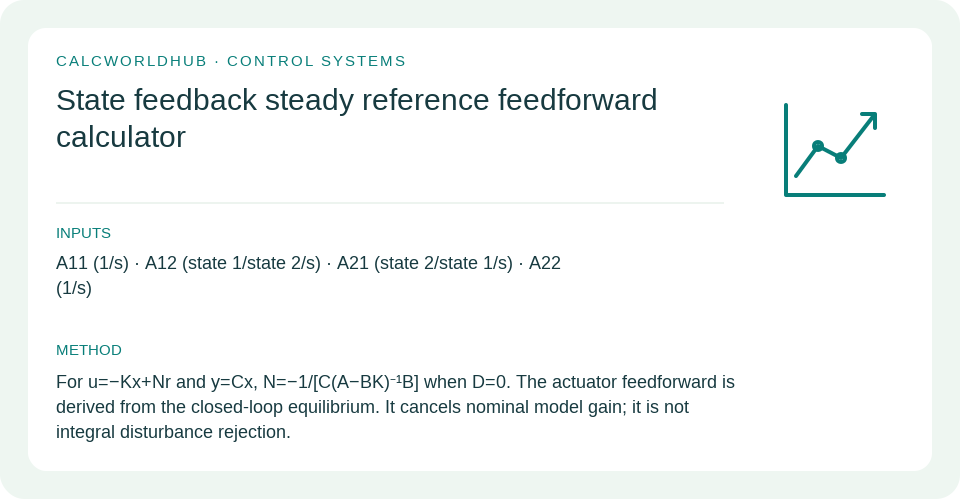
For u=−Kx+Nr and y=Cx, N=−1/[C(A−BK)⁻¹B] when D=0.
The actuator feedforward is derived from the closed-loop equilibrium. It cancels nominal model gain; it is not integral disturbance rejection.
What to enter
a— A11 (1/s)- First row, first column of the state matrix.
b— A12 (state 1/state 2/s)- Contribution of state two to the time derivative of state one.
c— A21 (state 2/state 1/s)- Coupling from the first state into the second derivative.
d— A22 (1/s)- Second row, second column of the state matrix.
g— B1 (state 1/input/s)- First component of the actuator input vector.
j— B2 (state 2/input/s)- Second component of the actuator input vector.
h— Output coefficient C1- Output sensitivity to state one.
k— Output coefficient C2- Output sensitivity to state two.
k1— State feedback K1- Feedback coefficient for state one.
k2— State feedback K2- Feedback coefficient for state two.
Interpreting the result
Requires a stable closed-loop model, no direct feedthrough and nonzero finite DC gain. Stability is not checked here.
Reading the outputs
N multiplies the reference before the actuator summing junction; DC gain is the reciprocal quantity before this correction.
Frequently asked questions
Does this reject an unknown load disturbance?
No; model-based feedforward cannot replace integral feedback.
Can N be negative?
Yes, if the closed-loop DC gain is negative.
What if state feedback changes?
Recalculate N because the closed-loop equilibrium gain changes.
How do I use the State feedback steady reference feedforward calculator?
Enter A11 (1/s), A12 (state 1/state 2/s), A21 (state 2/state 1/s), A22 (1/s), then complete the remaining labeled fields. Match the units shown beside each field and review the result together with the assumptions below.
What is a worked example of State feedback steady reference feedforward?
A11 (1/s) = 0; A12 (state 1/state 2/s) = 1; A21 (state 2/state 1/s) = -2; A22 (1/s) = -3; B1 (state 1/input/s) = 0; B2 (state 2/input/s) = 1; Output coefficient C1 = 1; Output coefficient C2 = 0; State feedback K1 = 18; State feedback K2 = 6. Reference feedforward multiplier: 20 input/output Closed-loop DC gain before feedforward: 0.05 output/input Use the default two-state plant with feedback gains (18,6) and position output to obtain unit steady reference tracking.
Read our calculation methodology.