Stellar distance from luminosity and flux calculator
Estimate source distance from luminosity and measured flux. Enter your values below for a free estimate, with no account required.
Calculator
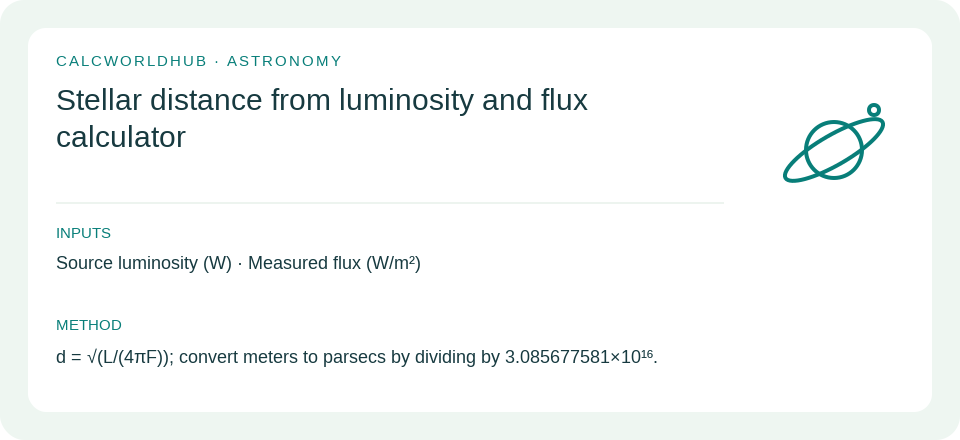
How to use this calculator
Estimate stellar distance from luminosity and observed flux using the inverse-square relation, with output converted to parsecs.
- Enter Source luminosity (W), Measured flux (W/m²). Match the units shown beside each field and review the result together with the assumptions below.
- Read the worked example below to check the expected input format and result.
- Compare another scenario by changing one input at a time. Use Reset to return to the starting values.
Infer distance from luminosity and observed flux
For an isotropic source with no intervening attenuation, flux is luminosity spread over a sphere. Only luminosity and flux determine this distance, so two unused distance fields were removed.
Inputs and units
- Source luminosity (W)
- Measured flux (W/m²)
Formula and method
d = √(L/(4πF)); convert meters to parsecs by dividing by 3.085677581×10¹⁶.
Worked example
For L=3.828×10²⁶ W and F=3.2×10⁻¹⁰ W/m², d≈10 pc.
Interpreting the result
Higher luminosity at fixed flux implies greater distance; higher measured flux implies shorter distance.
Assumptions and limits
Assumes isotropic emission and negligible extinction. Dust, beaming, variability, and measurement band differences can bias the inference.
Method references
Frequently asked questions
Why are two distance fields absent?
The inverse-square relation solves distance from luminosity and flux; an entered distance does not change that result.
How do I use the Stellar distance from luminosity and flux calculator?
Enter Source luminosity (W), Measured flux (W/m²). Match the units shown beside each field and review the result together with the assumptions below.
What is a worked example of Stellar distance from luminosity and flux?
For L=3.828×10²⁶ W and F=3.2×10⁻¹⁰ W/m², d≈10 pc.
What does the Stellar distance from luminosity and flux calculator calculate?
Estimate stellar distance from luminosity and observed flux using the inverse-square relation, with output converted to parsecs.
What assumptions apply to Stellar distance from luminosity and flux?
Assumes isotropic emission and negligible extinction. Dust, beaming, variability, and measurement band differences can bias the inference.
Good calculators show their work.
CalcWorldHub is built around clear inputs and visible assumptions. Results are estimates for planning; check official sources or your provider’s terms when exact figures matter.