Stellar luminosity from flux calculator
Infer isotropic source luminosity from measured flux and distance by reversing spherical inverse-square dilution.
Calculator
How to use this calculator
Infer isotropic source luminosity from measured flux and distance by reversing spherical inverse-square dilution.
- Enter Distance (parsecs), Measured flux (W/m²). Match the units shown beside each field and review the result together with the assumptions below.
- Read the worked example below to check the expected input format and result.
- Compare another scenario by changing one input at a time. Use Reset to return to the starting values.
Stellar luminosity from flux calculator
Infer isotropic source luminosity from measured flux and distance by reversing spherical inverse-square dilution.
Inputs and units
- Distance (parsecs): Positive source-to-observer distance; the calculator converts parsecs to metres before applying inverse-square dilution.
- Measured flux (W/m²): Received power per unit area, in watts per square metre, after any extinction correction required by the intended model.
Formula and method
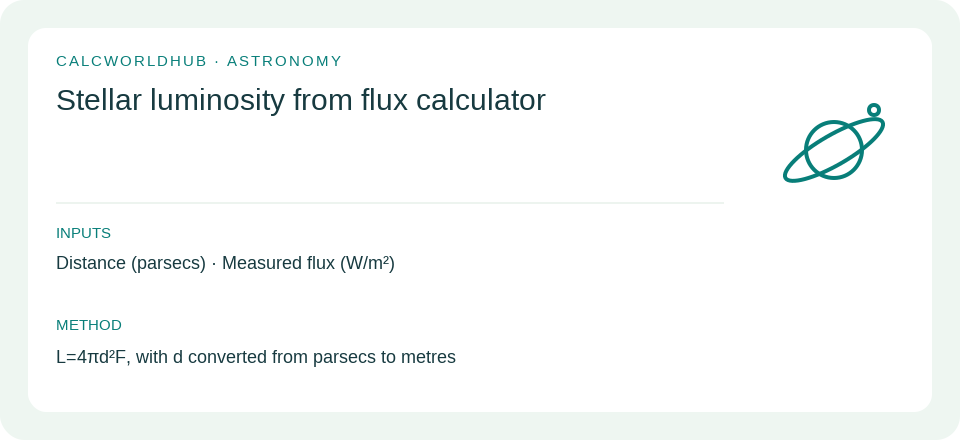
L=4πd²F, with d converted from parsecs to metres
Worked example
For d=10 pc=3.08568×10¹⁷ m and F=3.2×10⁻¹⁰ W/m², L≈3.8288×10²⁶ W.
Interpreting the result
The result is the power implied by the isotropic model; doubling distance at fixed flux quadruples inferred luminosity.
Assumptions and limits
Assumes flux is corrected for extinction and source radiation is isotropic; distance must be positive and flux nonnegative.
Sources and method
- Explains the inverse-square change in observed brightness with distance from a light source. NASA Imagine: brightness as a function of distance
Frequently asked questions
Which inputs determine this result?
The visible inputs are Distance (parsecs), Measured flux (W/m²). Each is used by the displayed formula; the calculator does not use any other hidden measurement.
When does this method apply?
Assumes flux is corrected for extinction and source radiation is isotropic; distance must be positive and flux nonnegative.
How do I use the Stellar luminosity from flux calculator?
Enter Distance (parsecs), Measured flux (W/m²). Match the units shown beside each field and review the result together with the assumptions below.
What is a worked example of Stellar luminosity from flux?
For d=10 pc=3.08568×10¹⁷ m and F=3.2×10⁻¹⁰ W/m², L≈3.8288×10²⁶ W.
What does the Stellar luminosity from flux calculator calculate?
Infer isotropic source luminosity from measured flux and distance by reversing spherical inverse-square dilution.
See the calculation methodology.
Good calculators show their work.
CalcWorldHub is built around clear inputs and visible assumptions. Results are estimates for planning; check official sources or your provider’s terms when exact figures matter.