How to use this calculator
Use core geometry and index contrast to assess a step-index fiber normalized frequency and its ideal single-mode cutoff.
- Enter Core radius (µm), Core refractive index, Cladding refractive index, Vacuum wavelength (nm). Match the units shown beside each field and review the result together with the assumptions below.
- Read the worked example below to check the expected input format and result.
- Compare another scenario by changing one input at a time. Use Reset to return to the starting values.
Step index fiber normalized frequency and mode regime explained
At fixed refractive indices, normalized frequency rises with core radius and falls with vacuum wavelength; compare V with the LP₁₁ cutoff near 2.405.
How the calculation works
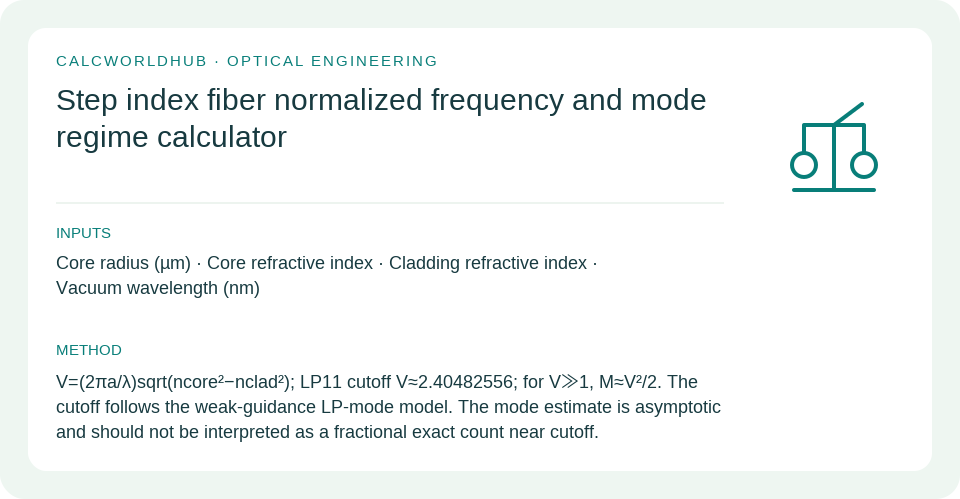
V=(2πa/λ)sqrt(ncore²−nclad²); LP11 cutoff V≈2.40482556; for V≫1, M≈V²/2.
The cutoff follows the weak-guidance LP-mode model. The mode estimate is asymptotic and should not be interpreted as a fractional exact count near cutoff.
Set up the calculation
radius— Core radius (µm)- Physical core radius, not diameter.
core— Core refractive index- Real step-index core index.
cladding— Cladding refractive index- Lower cladding index.
wavelength— Vacuum wavelength (nm)- Monochromatic vacuum wavelength in nanometres.
Limits of this model
Ideal circular weakly guiding step-index fiber only. Bend, leaky modes and profile details shift practical specifications.
Check this example
Core radius (µm) = 4.1; Core refractive index = 1.45; Cladding refractive index = 1.444; Vacuum wavelength (nm) = 1550.
- Normalized frequency V: 2.190065
- LP11 cutoff wavelength: 1411.5785 nm
- Large V guided mode estimate: 2.398191 modes including polarization
A 4.1 µm radius core with indices 1.45 and 1.444 at 1550 nm has V around 2.19, below the LP11 cutoff.
Reading the outputs
V is dimensionless. Cutoff is vacuum wavelength in nm; the large-V mode estimate includes both polarization states.
Frequently asked questions
Does V below 2.405 mean no mode propagates?
No. The fundamental guided mode remains while the next LP mode is below cutoff.
Is core radius the mode-field radius?
No. They are different quantities.
Can I round the asymptotic mode estimate to an exact count?
Not near cutoff; the formula is only reliable at large V.
How do I use the Step index fiber normalized frequency and mode regime calculator?
Enter Core radius (µm), Core refractive index, Cladding refractive index, Vacuum wavelength (nm). Match the units shown beside each field and review the result together with the assumptions below.
What is a worked example of Step index fiber normalized frequency and mode regime?
Core radius (µm) = 4.1; Core refractive index = 1.45; Cladding refractive index = 1.444; Vacuum wavelength (nm) = 1550. Normalized frequency V: 2.190065 LP11 cutoff wavelength: 1411.5785 nm Large V guided mode estimate: 2.398191 modes including polarization A 4.1 µm radius core with indices 1.45 and 1.444 at 1550 nm has V around 2.19, below the LP11 cutoff.
Background or definition reference: MIT optics lecture notes.
Read our calculation methodology.